
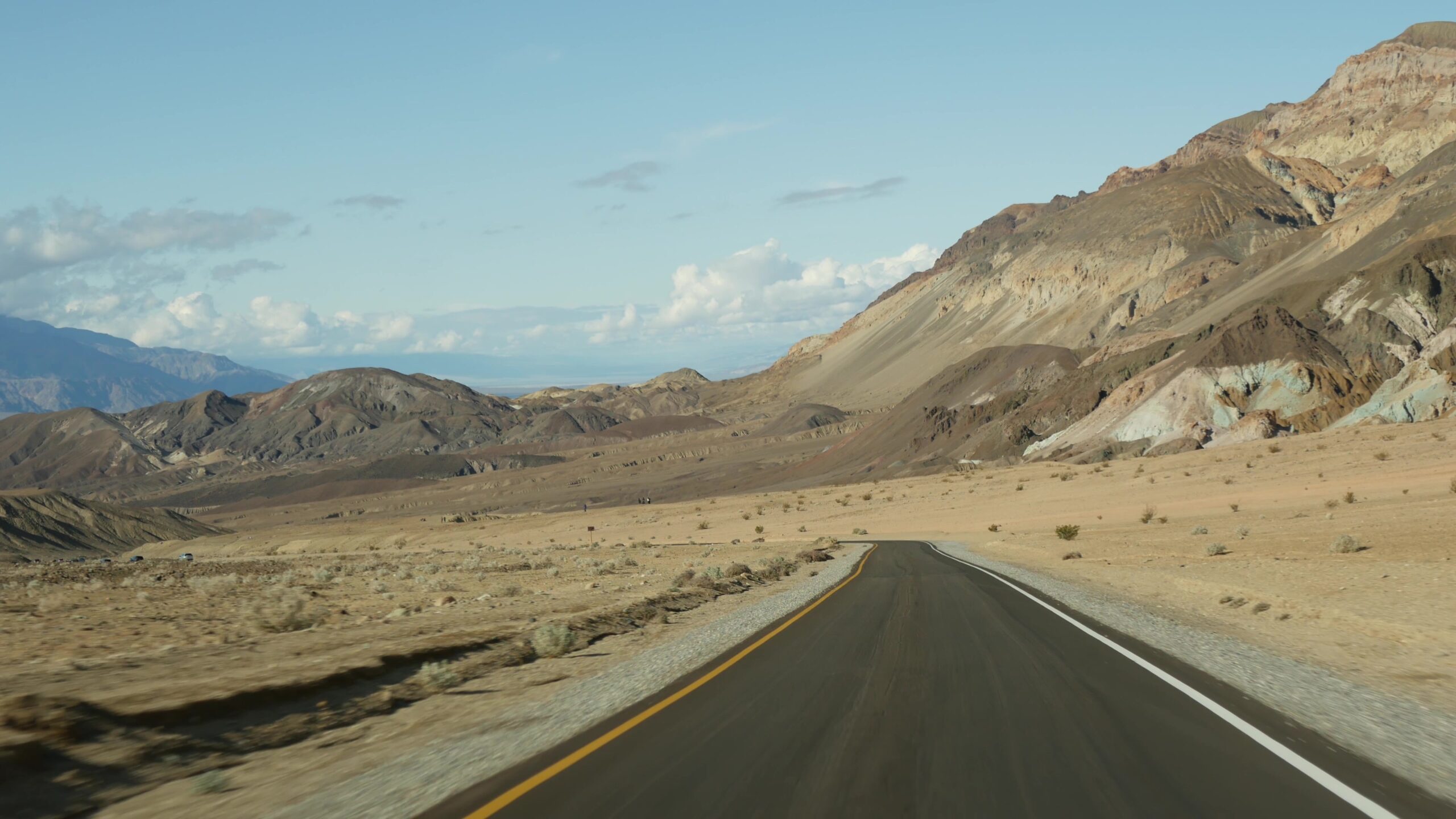
If your car becomes stuck or breaks down in Death Valley, the safest response is usually to stay with it rather than start walking. The vehicle gives you shade, carries your emergency water and is far easier for rescuers to see. In much of the park, mobile coverage is limited or nonexistent and help may be hours away.
That advice matters even more in extreme heat. On 17 August 2026, two French visitors became stranded when their vehicle got stuck in mud on West Side Road, near Queen of Sheba Mine Road. The temperature reached 116°F (about 47°C). They began walking across the salt flats towards Badwater Road; one of them died. The National Park Service left the cause of death for the coroner to determine, but used the incident to warn visitors about the combined risks of heat, distance and remoteness.
A safe Death Valley drive therefore starts before the engine does. Choose a route your vehicle can handle, check live road conditions, carry enough water for a long delay and decide how you would call for help without a phone signal.
Match the road to the vehicle
Most first-time visitors can see the park’s main sights from paved roads in a standard car. Backcountry routes are different. Dirt, gravel, deep sand, sharp rocks, mud and flood damage can turn an ordinary rental car into the wrong vehicle very quickly.
Check the park’s current conditions for the exact road, not merely for Death Valley as a whole. Conditions can change after rain or flooding, and a route shown by a navigation app may be closed or unsuitable. The official conditions page, checked on 13 September 2026, stated that Titus Canyon Road would close for repairs from 1 October 2026 to 30 September 2027. Treat any dated example as a prompt to check again, not as a forecast for your trip.
The road classification matters as much as the closure list. A maintained dirt road may be passable in a high-clearance two-wheel-drive vehicle, while another requires four-wheel drive, suitable tyres and off-road experience. If the park guidance calls for equipment or skills you do not have, change the route. A scenic detour is not worth testing the limits of a rental car in remote desert terrain.
Check the rental agreement before leaving the desk
Many rental agreements restrict driving on unpaved roads. Recovery from a dirt road may also fall outside roadside-assistance cover. Before accepting the car, check both the contract and the equipment: the spare tyre must be inflated and accessible, while the jack and wheel wrench need to be present and usable.
A crossover badge does not automatically make a vehicle suitable for a rough backcountry route. Ground clearance, tyres and the ability to drive all four wheels matter. If there is any doubt, keep the trip on paved roads and ask the rental company what its cover permits.
Pack for a delay, not just for the drive
Death Valley’s summer guidance recommends at least one gallon, or roughly four litres, of drinking water per person per day. That is a daily minimum, not the emergency reserve. Carry extra water in the car in case a puncture, mechanical fault or closure leaves you waiting.
For an unpaved or remote road, the National Park Service also advises carrying:
- a full fuel tank before setting out;
- extra food and water for people and the vehicle;
- at least one inflated spare tyre, preferably two on remote routes;
- a tyre repair kit and 12-volt air compressor;
- a complete jack and wheel wrench;
- basic tools and a shovel;
- a current paper map;
- a satellite communicator or emergency beacon where mobile service is unavailable.
Know how to use the equipment before the trip. A repair kit buried beneath luggage or a jack missing its handle will not solve a puncture at the roadside.
Share the route and an expected return time with someone who is not travelling with you. Download the Death Valley section of the NPS app for offline use, but keep a map as well. The park warns that GPS directions can lead drivers towards dead ends, closed roads or routes their vehicle cannot manage.
What to do when the vehicle stops
Stop and assess the immediate danger. If you have mobile service, call 911 and give your location, route and direction of travel as precisely as possible. If you have no phone signal, use the emergency or SOS function on your satellite communicator or beacon according to its instructions. Do not assume a phone will find a signal once you move away from the car.
Unless fire, flooding or another immediate hazard makes the location unsafe, stay with the vehicle. It provides shade and shelter, holds your supplies and gives search teams a much larger target than a person on foot. Raise the bonnet to signal trouble. On a remote road, the park also suggests marking a large X that can be seen from the air.
Use water steadily rather than waiting until you feel ill. Dizziness, nausea and headache can be warning signs of heat illness. Move out of direct sun, stop exertion and cool the body. A breakdown is no longer a mechanical inconvenience when the temperature makes every physical effort costly.
Do not keep spinning the wheels in mud or soft sand if that is digging the vehicle deeper. Do not leave the designated road to drive around a damaged section: off-road driving is illegal in the park and can place the car on even less stable ground.
If you are considering walking for help
Walking should not be the automatic next step. A road or building that appears close can be much farther away across open desert, and leaving the car removes both shade and visibility.
The park’s backcountry guidance says that anyone who decides to walk should stay on a main road rather than cut across country. In hot conditions, wait until after sunset and carry enough water. Leave a dated note in the vehicle stating the planned route and destination so rescuers know where to look.
This is a last-resort decision, not a way to rescue a tight itinerary. If you cannot describe a known route to help, cannot carry sufficient water or would be crossing open terrain in extreme heat, remaining with the vehicle gives rescuers the clearer chance of finding you.
Paved roads still demand care
Keeping to paved roads reduces the risk of becoming bogged down, but it does not remove the hazards of Death Valley. The park’s roads can be narrow and winding, with long descents and few places to stop. The National Park Service identifies single-vehicle rollovers as a major fatal risk. Observe speed limits, wear seat belts and use a lower gear on steep downhill sections rather than relying continuously on the brakes.
In periods of extreme heat, stay close to the car and avoid hiking at lower elevations. Build the day around short stops rather than a long walk from the vehicle. The coolest part of a summer day is usually around sunrise, but overnight temperatures can remain very high, so an early start does not remove the need for water and an emergency plan.
Rain creates a different problem. Flash floods can damage roads well after a storm has passed or make an unpaved surface impassable. If a wider US Southwest itinerary also includes Arizona, check the current Grand Canyon flash-flood closures separately; conditions in one national park say nothing about access in another.
Should you drive through Death Valley in summer?
A short visit on open paved roads can be reasonable when the car is reliable, the forecast has been checked and everyone has ample water. A remote dirt-road trip requires the correct vehicle, recovery equipment, communications and experience. From April to mid-October, the park warns that backcountry travel can be especially dangerous because a disabled vehicle becomes a survival problem in desert heat.
Postpone the backcountry element if the vehicle, rental terms or emergency plan do not fit the route. There is no need to prove that a road is technically passable. The sound decision is the one that leaves a margin for a puncture, a closure or several hours without help.
Before entering the park, make three final checks: the precise road is open, the vehicle is permitted and capable, and your water and communications would cover a long delay. If the car then stops, stay visible, stay sheltered and stay with it unless the location itself presents an immediate danger.

Hello! I’m Ben Fischer, a travel enthusiast who has journeyed far and wide to bring you unique and inspiring stories. Each destination is a new adventure for me, a chance to explore diverse cultures and share unforgettable experiences.
In my articles, I take you beyond mere descriptions of places. I share the encounters, special moments, and anecdotes that make each trip unique. My writing is an invitation to see the world through my eyes, blending practical tips with personal insights.
As a lifelong traveler, I approach each journey with respect and curiosity, eager to uncover the stories hidden in every corner of the globe.
