
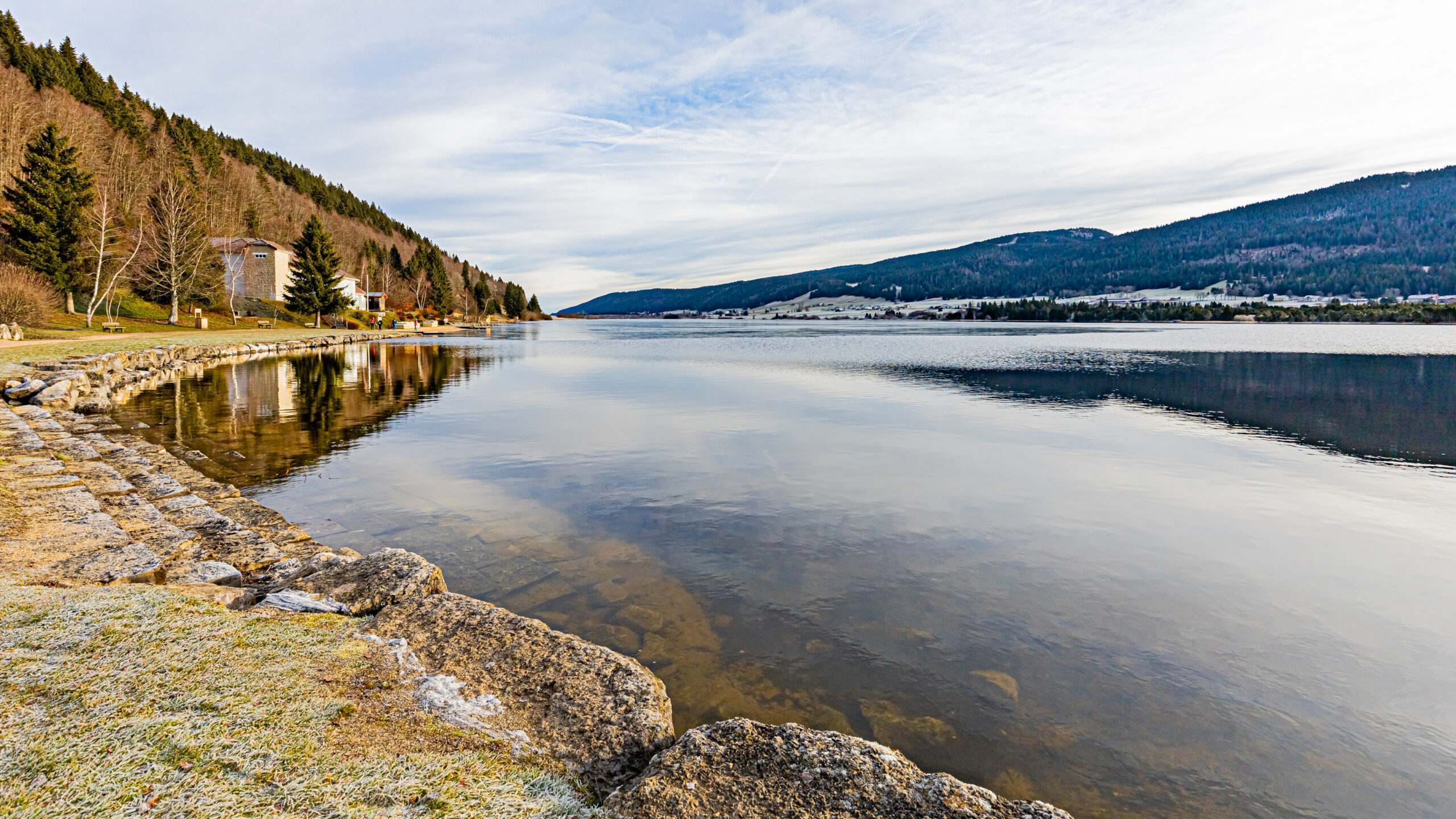
The Arbez Hotel in La Cure, in the French Haut-Jura region, has been split in half by the French-Swiss border since 1863. The building belongs to both the commune of Les Rousses in France and Saint-Cergue in Switzerland. Some rooms span both countries, the staircase changes nationality at the 7th step, and the dining room operates under two different legal systems. The establishment functions as a regular mountain hotel, but with this unique characteristic that attracts curious visitors and history enthusiasts. The Arbez family has managed it since 1921.
A Mountain Hotel Across Two Nations
The establishment features 10 rooms with wood paneling and mountain decor, in the spirit of a Haut-Jura après-ski lodge. Rates start at €89 ($95) for a double room, €109 ($117) for three people. The Les Rousses ski resort is just a few kilometers away. The brasserie serves regional cuisine, notably the perch fillets with savagnin wine and morel mushrooms mentioned by several guests.
On Tripadvisor, the hotel divides visitors. Some appreciate the authentic charm and unique atmosphere, while others note that the establishment is somewhat dated and could use renovation. The proximity to the border road generates fairly early morning traffic, but those who accept these shortcomings enjoy a place steeped in history, with its triangular flag and border markers visible on the facade. Parking is free on the French side.
Built by a Smuggler in 1863
In December 1862, Napoleon III and Switzerland signed the Treaty of Dappes to redraw the border. The text wouldn’t be ratified until February 1863. Between these two dates, a certain Ponthus, a local smuggler whose land was affected by the new boundary line, quickly constructed a house right on the border. Swiss authorities asked him to stop construction—he continued anyway.
Lucky for him: Article VII of the treaty specified that it would not affect any rights acquired at the time of the exchange of ratifications. Ponthus’s building could no longer be demolished. He turned it into a bar on the French side and a shop on the Swiss side—perfect for his smuggling activities. When he died in 1895, his sons converted it into a hotel. Jules-Joseph Arbez bought the establishment in 1921 and named it “Hotel Franco-Suisse.” As winter sports developed in the region, the hotel became a local curiosity.

The Staircase That Saved Hundreds of Lives
During World War II, the occupied zone extended right up to the hotel. Max Arbez, son of Jules-Joseph, used the building’s configuration to help hundreds of people escape to neutral Switzerland: Jews fleeing persecution, resistance fighters, British pilots. The Germans only had access to the French section—the bar and service area. The staircase begins in France but becomes Swiss from the 7th step onward. German authorities had the hotel walled up, to no avail.
On April 22, 2012, Max Arbez was recognized as Righteous Among the Nations by the Yad Vashem Institute. His widow Angèle, 103 years old, received the medal on his behalf in February 2013. After the war, Switzerland attempted to buy the entire hotel to simplify the border, without success. Edgar Faure, a member of parliament for the Jura, coined the nickname “Arbézie.” Max Arbez took the joke further by self-proclaiming a “Principality of Arbézie” in 1958, complete with a triangular flag, the Arbézian rupee currency, and honorary citizens including Charles de Gaulle and polar explorer Paul-Émile Victor.

Hello! I’m Ben Fischer, a travel enthusiast who has journeyed far and wide to bring you unique and inspiring stories. Each destination is a new adventure for me, a chance to explore diverse cultures and share unforgettable experiences.
In my articles, I take you beyond mere descriptions of places. I share the encounters, special moments, and anecdotes that make each trip unique. My writing is an invitation to see the world through my eyes, blending practical tips with personal insights.
As a lifelong traveler, I approach each journey with respect and curiosity, eager to uncover the stories hidden in every corner of the globe.
