
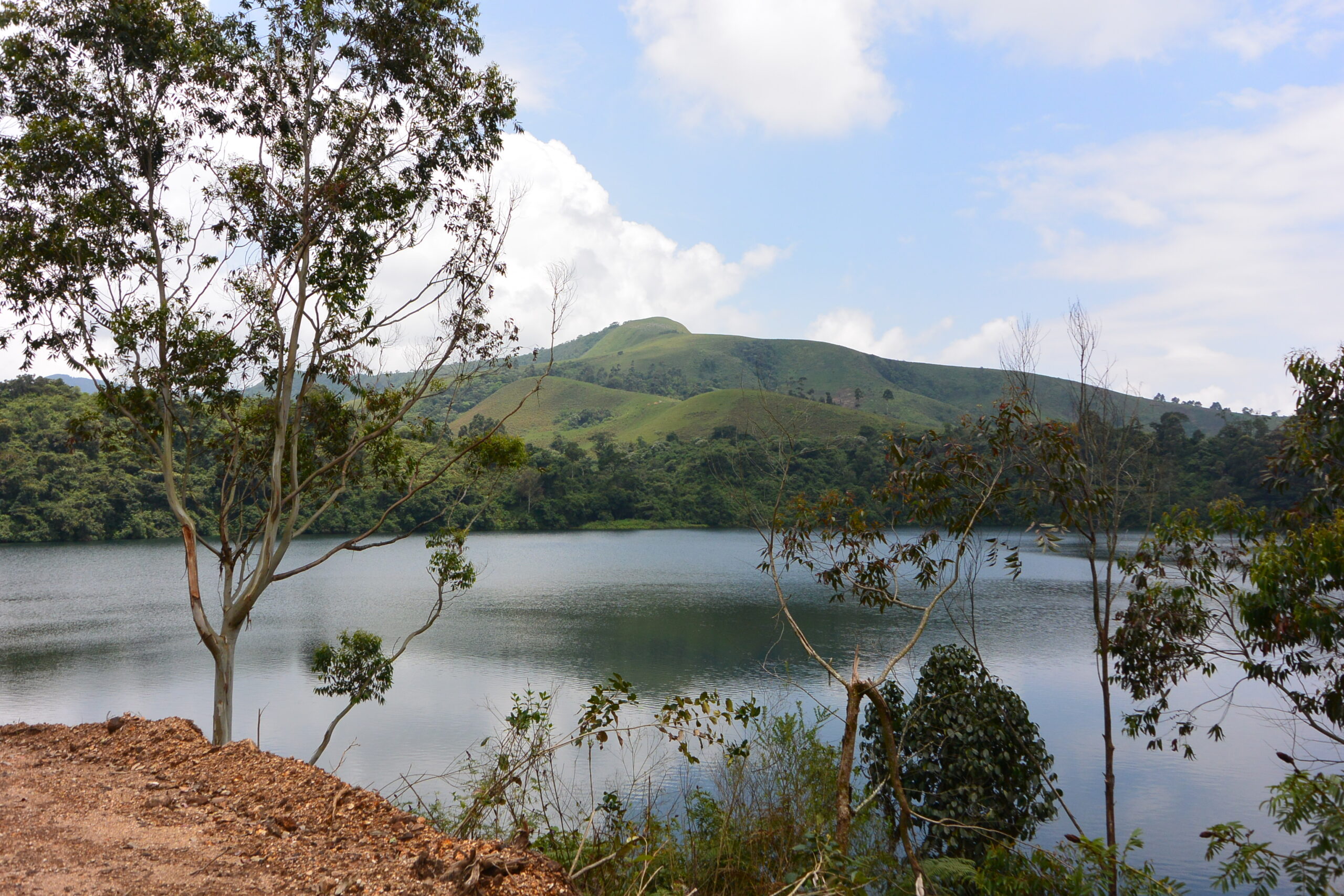
On the evening of 21 August 1986, Lake Nyos, a seemingly tranquil crater lake in north-west Cameroon, released a deadly surge of between 100,000 and 300,000 tonnes of carbon dioxide. This dense gas cloud swept down the surrounding hillsides at nearly 50 kilometres per hour, suffocating 1,746 people and almost 3,000 head of livestock within a 25-kilometre radius. Victims died in their sleep, without a sound or a flame. While houses and vegetation remained eerily untouched, the tragedy revealed a rare and terrifying geological phenomenon to the world: the limnic eruption.
How gas builds up at the bottom of a lake
Lake Nyos sits within a volcanic crater at an altitude of 1,091 metres. Beneath the lakebed, a pocket of magma continuously leaks CO₂ through fissures into the water. The deeper the water, the higher the pressure—and it is this pressure that allows the gas to dissolve into the water without forming bubbles, much like a sealed bottle of a fizzy drink. Over time, the bottom layers of the lake become heavily saturated with dissolved CO₂, creating a highly unstable solution.
The danger lies in the lake’s unique structure. Unlike lakes in temperate regions, where seasonal changes cause the water to mix and “breathe” regularly, Lake Nyos is located in the tropics. Here, the surface water remains warm year-round, acting as a lid that prevents the layers from mixing. This allows gas to accumulate in the depths for years, or even centuries, without being released.
The “Champagne Effect”
On the night of the disaster, scientists believe a minor event—likely a landslide—disturbed this fragile balance. CO₂-saturated water was suddenly pushed to a shallower depth where the pressure was lower. Just like popping the cork on a bottle of champagne, the gas rapidly formed bubbles. These bubbles made the water lighter, causing it to rise even faster and drawing up more gas-heavy water from the bottom. A catastrophic chain reaction was triggered.
Because carbon dioxide is heavier than air, the released cloud hugged the ground instead of dispersing into the atmosphere. The gas flowed through the valleys like an invisible river, displacing all breathable oxygen in its path. Some victims were found as far as 27 kilometres away from the lake’s shore.
An ingenious solution to prevent a repeat
Since 2001, a French scientific team has implemented a permanent degassing system. The mechanism is remarkably simple: a polyethylene pipe is lowered into the gas-saturated deep waters. A pump initially draws the water to the surface, but as it rises and the pressure drops, gas bubbles begin to form naturally. These bubbles lift the water, creating a self-sustaining flow. Once started, the pump can be switched off; the system continues to run itself without any external power.
Today, water and CO₂ geyser up to 50 metres above the lake’s surface, allowing the gas to dissipate harmlessly. By 2011, two additional columns were installed to speed up the process. Measurements from 2016 confirm that the risk of another major eruption has been significantly reduced.
Lake Kivu: A far greater threat
Lake Nyos was not an isolated case. In 1984, Lake Monoun in western Cameroon also experienced a limnic eruption, claiming 37 lives. These tragedies have helped experts identify other high-risk sites globally. The most concerning of all is Lake Kivu, which straddles the border between Rwanda and the Democratic Republic of Congo.
Spanning 2,700 square kilometres, Lake Kivu contains roughly 300 cubic kilometres of carbon dioxide and 60 cubic kilometres of methane—over 300 times the amount of gas released at Lake Nyos. The presence of methane adds a terrifying new dimension: it is highly flammable and could trigger massive explosions if released. Nearly two million people live on the shores of Lake Kivu, many in the major cities of Goma and Gisenyi.
In response, several projects are now underway to extract the methane for energy. This serves a dual purpose: generating electricity for the region while gradually reducing the concentration of dissolved gas. Rwanda’s KivuWatt power plant, commissioned in 2016, already provides 26 megawatts to the national grid. However, while recent studies suggest gas levels are currently stable, the risk remains—particularly in a region prone to the seismic and volcanic activity that could one day disturb the lake’s delicate layers.

Hello! I’m Ben Fischer, a travel enthusiast who has journeyed far and wide to bring you unique and inspiring stories. Each destination is a new adventure for me, a chance to explore diverse cultures and share unforgettable experiences.
In my articles, I take you beyond mere descriptions of places. I share the encounters, special moments, and anecdotes that make each trip unique. My writing is an invitation to see the world through my eyes, blending practical tips with personal insights.
As a lifelong traveler, I approach each journey with respect and curiosity, eager to uncover the stories hidden in every corner of the globe.
