
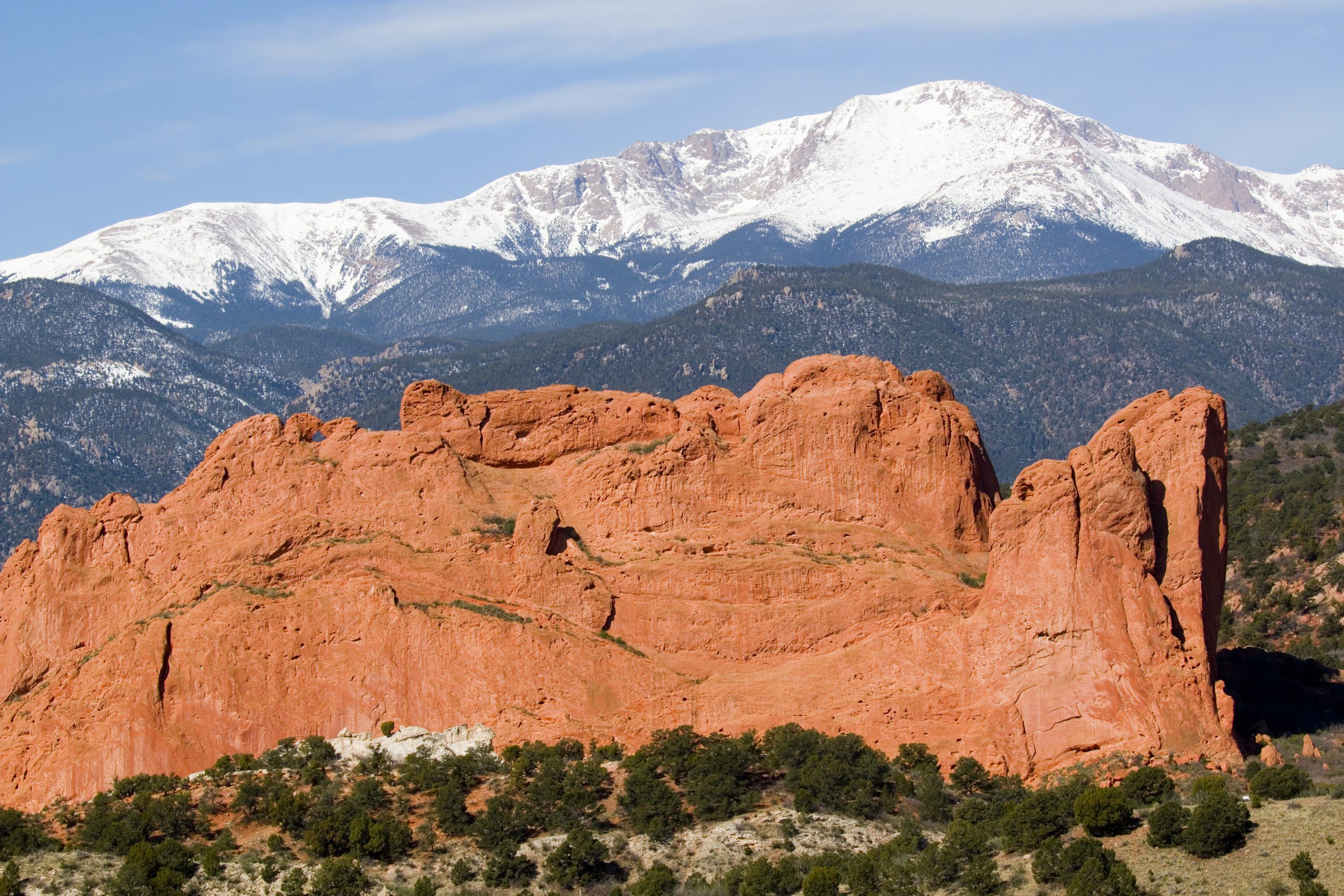
Pikes Peak deserves more than a quick summit photograph. Rising to 14,115 feet above Colorado Springs, the mountain brings together a vast Rocky Mountain view, the story behind America the Beautiful and a landscape that changes markedly from the foothills to the summit.
The trip works best when you treat the mountain as the centre of a wider place. At the top, the scale of the plains and peaks explains why Katharine Lee Bates found her opening image here. Lower down, Garden of the Gods frames the mountain behind upright red sandstone formations. Seeing both reveals more than either viewpoint can on its own.
This is a strong stop for travellers who value landscapes with a cultural story. It is less convincing if you only want to tick off a high summit before moving on.
The view that became America the Beautiful
Katharine Lee Bates arrived in Colorado Springs in the summer of 1893 to teach at a local summer school. At the end of her stay, she travelled to the top of Pikes Peak in a prairie wagon. The view across the mountains and plains supplied the opening imagery for the poem that became America the Beautiful.
The familiar song did not appear fully formed on that journey. Bates published the poem as America in 1895. Its best-known pairing with Samuel A. Ward’s tune Materna followed in 1910, and Bates published a final version of the words in 1913.
That history changes the summit from a scenic platform into a cultural landmark. The phrase about purple mountain majesties belongs to a specific view, seen after a long journey across the country. The plains below matter as much as the high ground around them.
Pikes Peak received National Historic Landmark status in 1961. Its significance therefore extends beyond height or ease of access: the mountain holds a documented place in the way the American landscape has been described and imagined.
Why the summit feels different from an ordinary viewpoint
The Pikes Peak Highway climbs through 19 miles of mountain terrain. Pull-offs reveal how quickly the surroundings change as the road rises from forest towards the exposed summit. The final view is broad rather than intimate. Colorado Springs lies far below, the Great Plains stretch east and the Rocky Mountains break the horizon in other directions.
At this height, the landscape has little visual clutter. Rock, low vegetation, sky and distance take over. That simplicity is the point. The summit makes the scale of the region legible in a way that a photograph taken from the city cannot.
The modern Summit Visitor Center, opened in 2021, makes the top more accessible than many Colorado fourteeners. Its indoor exhibits cover the mountain’s history, geography and natural environment, while accessible outdoor walkways keep the view at the centre of the visit. Travellers who cannot undertake a high-altitude hike can still experience the summit landscape directly.
The visitor centre also offers shelter, food and somewhere to pause. That matters at 14,115 feet, where cold, wind and reduced oxygen can turn a casual stop into a tiring one.
Garden of the Gods completes the picture
Pikes Peak is most rewarding when paired with Garden of the Gods, a free public park on the edge of Colorado Springs. From the park, the mountain rises behind red rock fins and balanced formations. The summit is no longer an isolated point above the city; it becomes the backdrop to a much older geological story.
The rocks in the Garden record changing environments. Sand, gravel and marine deposits accumulated as ancient mountains eroded and seas advanced and retreated. Later uplift pushed the layers upright, and erosion exposed the formations visible today.
This lower landscape provides a useful contrast with the summit. Pikes Peak offers distance and scale. Garden of the Gods gives you texture, colour and closer views of the forces that shaped the region. A short walk among the formations can make the mountain more interesting when you see it again from the city or from the road above.
The park also has a public history of its own. In 1909, the children of Charles Elliott Perkins conveyed 480 acres to Colorado Springs on the condition that the land remain free to the public. It is still a city park rather than a national park, despite its monumental appearance.
Who should make Pikes Peak a dedicated stop?
Pikes Peak is worth setting aside time for if at least two parts of the experience appeal to you: a very high summit, the America the Beautiful story, accessible mountain interpretation or the contrasting landscape at Garden of the Gods.
The combination suits a first visit to Colorado particularly well. You can understand the transition from plains to foothills and high mountain without committing to a technical climb. Families and mixed-mobility groups can share much of the summit experience, although altitude may affect each person differently.
Photographers gain two distinct perspectives. Garden of the Gods gives the classic red-rock foreground with Pikes Peak behind it. The summit reverses the relationship and looks outward across the region. Clear conditions matter, but the destination still has cultural and geological depth when distant views are limited.
Travellers primarily seeking wilderness or a solitary summit may find the developed top too busy. The highway, railway and visitor centre make Pikes Peak unusually accessible, and that popularity changes the atmosphere. A quieter Colorado mountain experience requires a different objective.
Allow enough time for the mountain to become a place
The City of Colorado Springs advises allowing two to three hours for the return highway journey from the entrance to the summit. That is a minimum framework rather than a complete day in the region. Stops at the pull-offs, time inside the visitor centre and a separate visit to Garden of the Gods can easily justify most of a day.
Do not build a tight onward schedule around the summit. The highway operates throughout the year only when weather permits, and conditions can change after the gates open. Check the current road status on the day of the visit.
If you plan to drive your own vehicle between 22 May and 30 September in 2026, you need both admission and a timed-entry reservation for the summit. The reservation provides a two-hour window to arrive at the Gateway. It does not guarantee that weather will keep the summit open.
This practical uncertainty is part of visiting a high mountain. Keep Garden of the Gods or another Colorado Springs stop available as the alternative, rather than treating a weather closure as a ruined day.
Take the altitude seriously
The summit stands far above the level at which altitude illness can affect an unacclimatised traveller. Fitness does not guarantee protection. Headache, dizziness, fatigue and nausea can appear after a rapid ascent, and the reduced oxygen makes even short walks feel harder.
Move slowly, drink water and avoid turning the summit walkways into an endurance test. If symptoms worsen while you rest, descend. Travellers with heart, lung or other relevant medical conditions should seek appropriate medical advice before a rapid trip to this height.
The summit is a day visit for most travellers, with the night spent much lower in Colorado Springs or the surrounding area. That makes the exposure easier than sleeping at 14,000 feet, but it does not make the altitude irrelevant.
The reason to go
Visit Pikes Peak for the relationship between the view and the place below it. The summit explains the scale of the landscape that inspired Katharine Lee Bates. Garden of the Gods shows how that mountain sits within a region of red rock, plains and uplifted terrain.
If you only collect summits, the developed top may feel brief. If you want to understand why this mountain became a national symbol, give it time, look east as well as west and see the peak once more from the red rocks below.

Hello! I’m Ben Fischer, a travel enthusiast who has journeyed far and wide to bring you unique and inspiring stories. Each destination is a new adventure for me, a chance to explore diverse cultures and share unforgettable experiences.
In my articles, I take you beyond mere descriptions of places. I share the encounters, special moments, and anecdotes that make each trip unique. My writing is an invitation to see the world through my eyes, blending practical tips with personal insights.
As a lifelong traveler, I approach each journey with respect and curiosity, eager to uncover the stories hidden in every corner of the globe.
