
Barcelona offers an exceptional blend of architecture, culture, and Mediterranean lifestyle. With world-renowned modernist buildings, medieval streets, and urban beaches, the Catalan capital attracts millions of visitors each year. To make the most of your trip, simplify your travel planning by reserving activities in advance, as major attractions often sell out weeks ahead, particularly during peak season.
Here are the experiences you shouldn’t miss !
Gaudí’s architectural masterpieces
Antoni Gaudí’s distinctive style defines Barcelona’s skyline. La Sagrada Familia, still under construction after 140 years, remains the city’s most visited monument. The basilica is expected to reach completion in 2026, becoming the world’s tallest church. Inside, stone columns branch upward like trees, creating a forest-like atmosphere enhanced by colorful light filtering through stained glass windows. The Passion and Nativity façades display intricate sculptural details, while tower access provides elevated views across the city.
Park Güell sits on a hillside in the northern part of Barcelona. The park’s serpentine bench, covered in colorful mosaic fragments, curves around a terrace overlooking the city. Two gingerbread-style houses mark the entrance, their rounded forms and vibrant tiles characteristic of Gaudí’s organic approach to design. The Greek Theatre area offers one of the best panoramic perspectives of Barcelona.
On Passeig de Gràcia, Casa Batlló and Casa Milà (La Pedrera) showcase Gaudí’s residential architecture. Casa Batlló underwent restoration in 2025, with €3.5 million invested to restore its faded colors and ornate features. The building’s wavy façade and bone-like balconies create an unusual visual effect. Casa Milà, with its undulating stone exterior and rooftop chimneys shaped like medieval knights, offers night tours and occasional live music events on the terrace.
The Gothic Quarter: medieval Barcelona
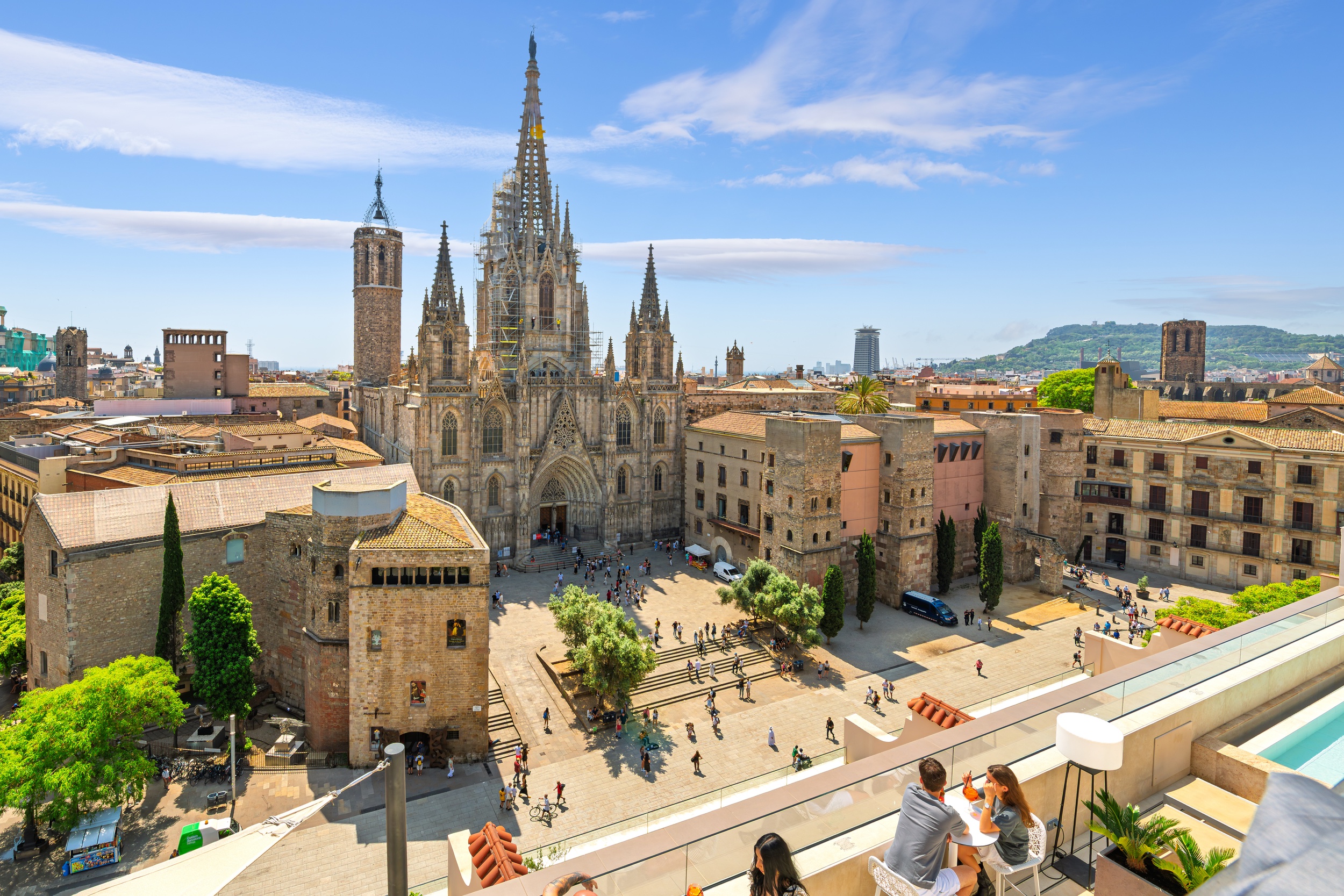
The Barri Gòtic occupies the site of Roman Barcino, founded in 15 BC. Narrow medieval streets form a labyrinth around Plaça Sant Jaume, where Barcelona’s City Hall faces the Palau de la Generalitat. The area preserves sections of the original Roman walls, visible along Carrer del Bisbe and near Plaça Ramon Berenguer.
Barcelona Cathedral dominates the quarter with its neo-Gothic façade, added between 1882 and 1913. The cloister contains 13 white geese, representing the age of Saint Eulalia at her martyrdom. The cathedral’s rooftop, accessible by elevator, provides views over the Gothic Quarter’s terracotta roofs and narrow passages.
On Carrer Paradís, hidden in a medieval courtyard, four nine-meter columns remain from the Roman Temple of Augustus. These 2,000-year-old structures mark one of Barcelona’s earliest historical layers. Entrance is free, making it one of the city’s accessible Roman sites.
Plaça Sant Felip Neri offers a quiet contrast to surrounding tourist activity. The square’s fountain sits peacefully in the center, but the walls bear shrapnel marks from a 1938 bombing during the Spanish Civil War that killed 42 people. The baroque church adds to the square’s contemplative atmosphere.
The neo-Gothic bridge on Carrer del Bisbe connects the Palau de la Generalitat with Casa dels Canonges. Built in 1928, it appears medieval but is entirely 20th-century construction. The street leads to several artisan shops and historic cafés.
Beach life at Barceloneta
Barceloneta Beach stretches 422 meters along Barcelona’s waterfront. The beach takes its name from the 18th-century maritime neighborhood built for port workers and fishermen. Today, the area combines traditional fishing quarter character with modern beach facilities.
The beach offers volleyball courts, children’s play areas, and fully accessible facilities including the Espai de Mar center for people with disabilities. The promenade runs parallel to the sand, lined with restaurants specializing in seafood and paella. Groups of friends gather on the beach to sunbathe and play music, while families occupy the calmer sections near the water.
The neighborhood itself maintains narrow grid streets where washing hangs from balconies and locals sit outside watching daily life. Mercat de la Barceloneta provides fresh seafood, produce, and local products. The market operates as a genuine local facility rather than a tourist attraction.
For quieter alternatives, Playa de Bogatell sits 20 minutes north along the coast. This 702-meter beach attracts more local residents and fewer tourists, with Blue Flag certification confirming water quality. The Olympic Marina area includes Nova Icària Beach, popular with families for its kid-friendly amenities and sports facilities including ping-pong tables and outdoor gym equipment.
La Rambla and La Boqueria Market
La Rambla connects Port Vell harbor with Plaça de Catalunya, running through the heart of Barcelona. The pedestrian boulevard features flower stands, street performers, and the mosaic pavement designed by Joan Miró. While the street itself serves mainly tourists, it provides access to surrounding neighborhoods and landmarks.
La Boqueria Market, just off La Rambla, operates as Barcelona’s main food market with over 300 stalls covering 2,583 square meters. The market dates back to 1217 and sells fresh seafood, cured meats, cheeses, fruits, and vegetables. Several bars inside serve prepared food, though prices reflect the market’s tourist popularity. Early morning visits show the market functioning as a working wholesale operation before tourist crowds arrive.
The Liceu opera house stands on La Rambla, hosting opera, ballet, and concerts. Ticket prices can be lower than contemporary music concerts, with performances most evenings during the season.
Montjuïc and mountain views
Montjuïc hill rises above Barcelona’s harbor, hosting several attractions from the 1929 International Exposition and 1992 Olympics. The Magic Fountain performs synchronized water and light shows, originally designed by Carles Buïgas. The fountain displays are particularly elaborate during New Year’s Eve celebrations.
Mount Tibidabo, Barcelona’s highest point in the Serra de Collserola range, offers panoramic views from its neo-Gothic basilica, the Temple Expiatori del Sagrat Cor. Built in the early 20th century, the church includes a viewing platform accessible by lift and steps. Tibidabo Amusement Park, one of the world’s oldest theme parks, operates on the same mountain with traditional rides including a carousel, Ferris wheel, and bumper cars.
Museums and culture
The Picasso Museum holds nearly 4,000 works spanning the artist’s career from early sketches to cubist experiments. Since April 2025, the museum offers free admission Thursday through Saturday evenings from 7-9pm, in addition to free Sunday visits. The museum occupies medieval palaces on Carrer de Montcada in the El Born neighborhood.
Palau de la Música Catalana, designed by Lluís Domènech i Montaner in 1908, represents Catalan modernisme architecture. The concert hall features elaborate decoration with ceramic mosaics, stained glass, and sculptural details. The building holds UNESCO World Heritage status and maintains an active performance schedule. Guided tours run throughout the day when performances aren’t scheduled.
Time Out Market Barcelona opened at Port Vell in July 2024, gathering 14 restaurants and four bars selected by local editors. The market occupies a terrace at Maremagnum with harbor views. Paradiso, one of the world’s ranked bars, operates within the market complex.

Hello! I’m Ben Fischer, a travel enthusiast who has journeyed far and wide to bring you unique and inspiring stories. Each destination is a new adventure for me, a chance to explore diverse cultures and share unforgettable experiences.
In my articles, I take you beyond mere descriptions of places. I share the encounters, special moments, and anecdotes that make each trip unique. My writing is an invitation to see the world through my eyes, blending practical tips with personal insights.
As a lifelong traveler, I approach each journey with respect and curiosity, eager to uncover the stories hidden in every corner of the globe.
