
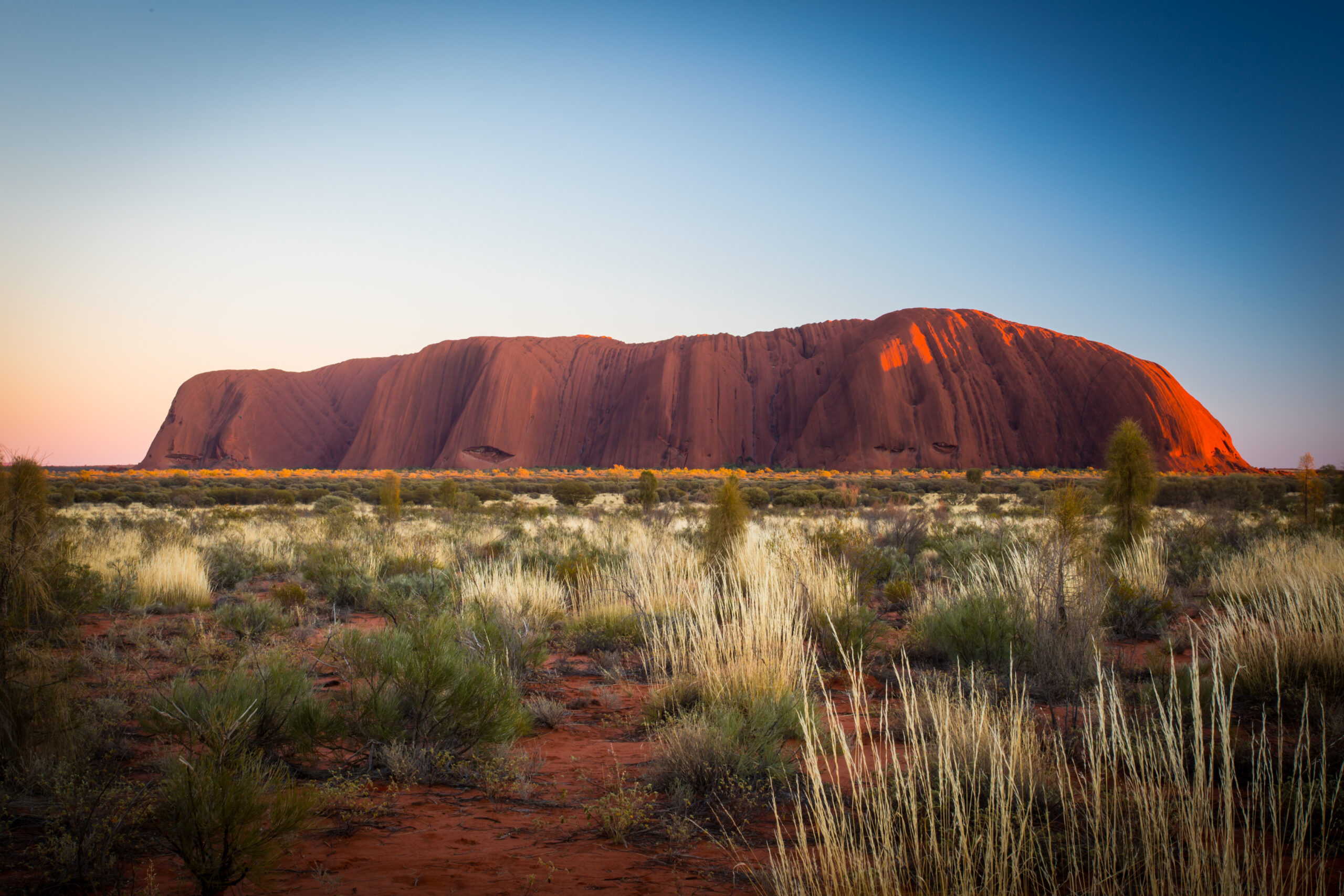
A while ago, we explored the wonders of Uluru, the iconic red monolith standing at the spiritual heart of Australia. For decades, climbing the rock was considered the “must-do” activity for any visitor to the Red Centre. However, that changed recently when the climb was permanently closed out of respect for the local Aboriginal people, for whom the site is deeply sacred. Furthermore, staying overnight within the National Park has strictly been off-limits. But that is about to change, with the launch of a new, exclusive multi-day guided trek.
The Uluru-Kata Tjuta Signature Walk
Set to be the highlight of 2026 for trekking enthusiasts, this immersive 54km journey spans five days and four nights. The route begins at the Olgas—more formally known as Kata Tjuta—and concludes at the base of Uluru itself. Crucially, the itinerary includes overnight stays inside the UNESCO World Heritage-listed National Park, a privilege normally unavailable to the public.
The trek will be led by guides from the Anangu community, the traditional owners and custodians of the land. This offers a rare opportunity for small groups (limited to 15 people) to gain profound insights into the culture, traditions, and spiritual significance of the area. Walkers will also have access to restricted areas that are usually closed to visitors, home to ancient and remarkable rock art. This “world-first” experience is scheduled to run from April to September each year, with prices starting at approximately £2,500 (€3,000) per person.
Where exactly is Uluru-Ayers Rock?
Located in the Northern Territory, Uluru-Ayers Rock sits at the very core of the Australian Outback—the vast, semi-arid interior of the continent. It lies within the Uluru-Kata Tjuta National Park, truly in the “middle of nowhere.” The nearest settlement is the small resort town of Yulara (population 1,000), 20km away, while the nearest major town, Alice Springs, is some 450km distant.
Geologically, Uluru is an “inselberg”—a literal “island mountain” that rises abruptly from the surrounding plains. Its famous deep-red hue is caused by the high iron oxide content in its minerals. With a circumference of 9.4km and a length of 2.5km, it stands about 350 metres above the plain, reaching a total elevation of 863 metres above sea level.
As for the name, “Uluru-Ayers Rock” combines two distinct histories. “Ayers Rock” was coined by European explorers who first reached the summit in 1873, naming it after a local politician. “Uluru” is the original name given by the local Aboriginal people.
It is precisely because of the site’s immense spiritual importance to Indigenous Australians that climbing is no longer permitted. The ban came into effect on 26 October 2019, marking the 34th anniversary of the land being handed back to its traditional owners. Prior to this, tens of thousands of visitors would make the climb every year.
The decision to close the climb was made jointly by the Anangu people and Australian authorities. While cultural and spiritual respect was the primary driver, safety and environmental concerns also played a role. The sheer volume of climbers over the decades had caused significant erosion and damage to the rock’s surface, not to mention numerous accidents on its steep slopes.
For those wondering if the climb might one day reopen, the answer is a firm no: the closure has been declared permanent and irreversible.

Hello! I’m Ben Fischer, a travel enthusiast who has journeyed far and wide to bring you unique and inspiring stories. Each destination is a new adventure for me, a chance to explore diverse cultures and share unforgettable experiences.
In my articles, I take you beyond mere descriptions of places. I share the encounters, special moments, and anecdotes that make each trip unique. My writing is an invitation to see the world through my eyes, blending practical tips with personal insights.
As a lifelong traveler, I approach each journey with respect and curiosity, eager to uncover the stories hidden in every corner of the globe.
