
Oceania > New Caledonia: Weather, Map, Costs and Travel Guide

New Caledonia : When and where to go?
Click on a city for complete climate and weather tables
| Town | Jan | Feb | Mar | Apr | May | June | July | Aug | Sept | Oct | Nov | Dec |
| Noumea |  | | |  | |  | |  | | | | |
New Caledonia: Climate & Weather
The climate, tropical oceanic in nature, is temperate and sunny. From November to April the hot season gives temperatures of around 25°C with frequent rainfall and sometimes hurricanes that can be quite violent.
The month that is generally hottest is February. From May to September the dry season is a little cooler but globally it is the springtime temperature that reigns from one end of the year to the other. August is the coldest month when temperatures can go down to 17°C.
There is therefore no definite time that is the best for visiting New Caledonia and its various attractions according to the different areas.
Weather today

Light Rain
max. 23 °C
min. 20 °C
Wind: 8 km/h
Precipitation forecast: 2,6 mm
> Full report and 7-days forecast
Data updated at 01:30 (local time)
At that time, the weather was:
 20 °C / Mostly Cloudy
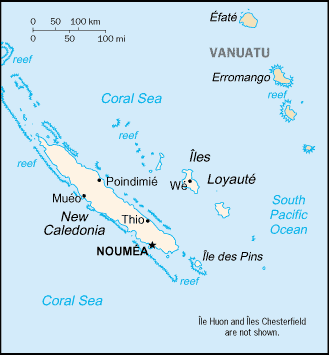
New Caledonia: Map
Sponsored links
What to do in New Caledonia
White sand beaches and coral reefs are images associated with New Caledonia; Noumea, the capital, lives up to this reputation with the famous Anse Vata beach, but it also has a charming port with a colourful assembly of boats of all kinds, the town centre with its pretty Place de Cocotiers and the Jean-Marie-Tjibaou cultural centre with its attractive architectural style.
Leaving Noumea you will find another side to New Caledonia. The Territorial Park of La Rivière Bleue is a real paradise where you can wander the paths that cross the forests of secular pines (one thousand years for the Grand Kouri!) and inhabited by exotic birds including the endemic Kagu bird, the country’s emblem, amongst others.
Bourail with its Pierced Rock in the form of a face and its Turtle bay are definitely worth a visit (if you are an early bird then you can watch for the turtles yourself) as well as the nearby Poé beach with its multicoloured shells.
Pine Island, to the south east of Grand Terre, has fantastic postcard-pretty beaches with turquoise waters that you can admire from higher up by climbing to the top of Mount N’Ga, only 262 metres high.
Leaving Noumea you will find another side to New Caledonia. The Territorial Park of La Rivière Bleue is a real paradise where you can wander the paths that cross the forests of secular pines (one thousand years for the Grand Kouri!) and inhabited by exotic birds including the endemic Kagu bird, the country’s emblem, amongst others.
Bourail with its Pierced Rock in the form of a face and its Turtle bay are definitely worth a visit (if you are an early bird then you can watch for the turtles yourself) as well as the nearby Poé beach with its multicoloured shells.
Pine Island, to the south east of Grand Terre, has fantastic postcard-pretty beaches with turquoise waters that you can admire from higher up by climbing to the top of Mount N’Ga, only 262 metres high.
New Caledonia: The basics
Numerous flights land at Noumea via Japan and Australia.
No visa is required for European citizens.
The currency in circulation is the Pacific franc which is aligned with the Euro. Bank cards are accepted just about everywhere.
The budget required is similar to that needed for France in summer. Lodging in Noumea is expensive but leaving the capital, a double room will cost you around €50 in an average hotel. However there are some great camping sites in some magnificent settings outside town. A meal will cost between €15-30.
There are no particular health precautions to take into consideration apart from protection against the mosquitoes that can carry dengue fever.
For travel inland, Air Calédonie provides a service of inland flights and buses leaving from Noumea travel to most villages in Grande Terre.
If you wish to take some souvenirs home with you then you will want to consider pareos, wooden statues and wicker work objects.
No visa is required for European citizens.
The currency in circulation is the Pacific franc which is aligned with the Euro. Bank cards are accepted just about everywhere.
The budget required is similar to that needed for France in summer. Lodging in Noumea is expensive but leaving the capital, a double room will cost you around €50 in an average hotel. However there are some great camping sites in some magnificent settings outside town. A meal will cost between €15-30.
There are no particular health precautions to take into consideration apart from protection against the mosquitoes that can carry dengue fever.
For travel inland, Air Calédonie provides a service of inland flights and buses leaving from Noumea travel to most villages in Grande Terre.
If you wish to take some souvenirs home with you then you will want to consider pareos, wooden statues and wicker work objects.


