
Europe > Bosnia: Weather, Map, Costs and Travel Guide

Bosnia : When and where to go?
Click on a city for complete climate and weather tables
| Town | Jan | Feb | Mar | Apr | May | June | July | Aug | Sept | Oct | Nov | Dec |
| Sarajevo |  | | |  | |  | | | | | | |
Bosnia: Climate & Weather
Bosnia is a country that has two very distinct climates: In the north you will find a semi-continental climate whereas the south has a more Mediterranean climate.
Due to this fact, differences in temperature are recorded over the whole of the country between summer and winter. The winter is harsh in the north but bearable in the south.
The differences in summer temperatures between the north and south are not very noticeable. Snow covers 60% of the country in winter which is definitely good news to winter sports enthusiasts.
The ideal times to visit Bosnia are during autumn or spring.
Weather today

Light Rain
max. 26 °C
min. 14 °C
Wind: 2 km/h
Precipitation forecast: 0,7 mm
> Full report and 7-days forecast
Data updated at 06:35 (local time)
At that time, the weather was:
 17 °C / Clear
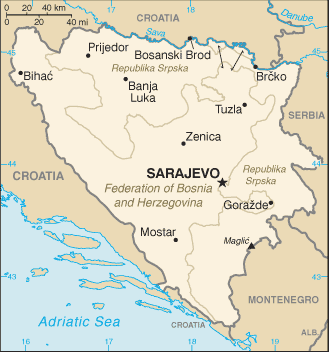
Bosnia: Map
Sponsored links
What to do in Bosnia
The Bosnian population, although they may have differences on religion and origin are in agreement on one particular aspect: They are Bosnian and patriots.
This cultural diversity is their greatest advantage in the current tourism market. Major religions are anchored in this population. The Croats brought Christianity, the Bosnians have stayed Muslim and the Serbs have always been orthodox. These religions showed their importance through the places of worship that were repaired in priority after the war as, after being a patriot, a Bosnian is also a person of faith.
Therefore, through the renovations completed by the population, the traces of various civilisations are still present in Bosnia. Sarajevo, the Capital, is a perfect example with its Ottoman, Austro-Hungarian and Bosnian style buildings.
Apart from these monuments, the nature reserves enable the observation of migrating birds. The reserves of Hutovo Blato, in the Néum, and those of Kozara, at the Banja Luka axe, Prijedor, are the favourite sites for admiring the birds’ flight and nature itself in an unsurpassed manner.
Bosnia has also become the Promised Land for extreme sports with the advent of rafting. With the arrival of parachuting and hang-gliding enthusiasts, Bosnia has shown itself to have some superb sites for this type of sport.
Rafting is very practical on the Una, at Bihaç which is two hours to the north of Zagreb. Next to Sarajevo there are two other perfect sites, Neretva and Rakitnica, a little to the south of the city. In winter however, rafting gives way to skiing: The ski stations at Babin Do, Jahorina and Vlasiç welcome those who enjoy downhill skiing.
Tourism operators are specialised in the creation of custom tours for extreme sports enthusiasts in Bosnia. They offer climbing, hiking along the Bogomil necropolises route at Bjelasnica etc….
This cultural diversity is their greatest advantage in the current tourism market. Major religions are anchored in this population. The Croats brought Christianity, the Bosnians have stayed Muslim and the Serbs have always been orthodox. These religions showed their importance through the places of worship that were repaired in priority after the war as, after being a patriot, a Bosnian is also a person of faith.
Therefore, through the renovations completed by the population, the traces of various civilisations are still present in Bosnia. Sarajevo, the Capital, is a perfect example with its Ottoman, Austro-Hungarian and Bosnian style buildings.
Apart from these monuments, the nature reserves enable the observation of migrating birds. The reserves of Hutovo Blato, in the Néum, and those of Kozara, at the Banja Luka axe, Prijedor, are the favourite sites for admiring the birds’ flight and nature itself in an unsurpassed manner.
Bosnia has also become the Promised Land for extreme sports with the advent of rafting. With the arrival of parachuting and hang-gliding enthusiasts, Bosnia has shown itself to have some superb sites for this type of sport.
Rafting is very practical on the Una, at Bihaç which is two hours to the north of Zagreb. Next to Sarajevo there are two other perfect sites, Neretva and Rakitnica, a little to the south of the city. In winter however, rafting gives way to skiing: The ski stations at Babin Do, Jahorina and Vlasiç welcome those who enjoy downhill skiing.
Tourism operators are specialised in the creation of custom tours for extreme sports enthusiasts in Bosnia. They offer climbing, hiking along the Bogomil necropolises route at Bjelasnica etc….
Bosnia: The basics
Travelling to Bosnia does not require a visa; a simple current passport is fine. There are however no motorways and if travel by car is undertaken then a fair amount of police checks should be expected. The Highway Code in Bosnia requires headlights to be on both day and night.
The Bosnian currency is the convertible Mark, to simplify the exchange rate you obtain 1.95 Bam for 1 Euro. The Euro can be used but it is not automatically accepted in transactions. Visa cards can be used in the Capital but are often refused in outlying areas.
You should confirm that all your vaccinations are up to date before leaving your home country. Once in Bosnia make sure you wash your hands thoroughly and regularly. Avoid eating raw or semi-cooked food.
Security in Bosnia is more stable since the end of the war. You should however be aware of minefields that are still to be found on 4% of Bosnian land.
The Bosnian currency is the convertible Mark, to simplify the exchange rate you obtain 1.95 Bam for 1 Euro. The Euro can be used but it is not automatically accepted in transactions. Visa cards can be used in the Capital but are often refused in outlying areas.
You should confirm that all your vaccinations are up to date before leaving your home country. Once in Bosnia make sure you wash your hands thoroughly and regularly. Avoid eating raw or semi-cooked food.
Security in Bosnia is more stable since the end of the war. You should however be aware of minefields that are still to be found on 4% of Bosnian land.


