
Asia > Philippines: Weather, Map, Costs and Travel Guide

Philippines : When and where to go?
Click on a city for complete climate and weather tables
| Town | Jan | Feb | Mar | Apr | May | June | July | Aug | Sept | Oct | Nov | Dec |
| Manila |  |  | | | |  | | | | | | |
Philippines: Climate & Weather
The tropical climate of the Philippines provides heat and humidity all the year round. However, there are different areas where the dry season and wet season alternate although the characteristics are essentially the same: From January to June, dryness prevails, and from July to December is the rainy season, with slight variations depending on the area.
Between May and November, the monsoon season often leads to the passage of typhoons. The coolest temperatures generally occur in January and the highest temperatures in May, however there is an average of around 25°C throughout the year.
The best time for travelling is from January to May, when you will avoid the typhoons, with a preference for March and April when it is easier to move from one island to another with good conditions.
Weather today

Overcast
Wind: 8 km/h
Precipitation forecast: 0 mm
> Full report and 7-days forecast
Data updated at 22:21 (local time)
At that time, the weather was:
29 °C / Overcast
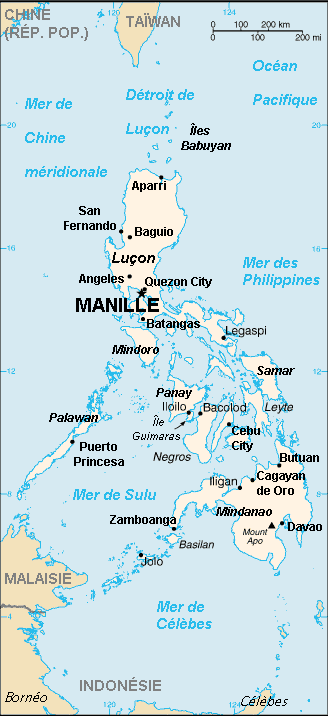
Philippines: Map
Sponsored links
What to do in Philippines
Manila with its 12 million people is stunning in its modernity but you can visit historic sites in the Intramuros district.
Banaue rice fields, forming a spectacular staircase carved into the mountain over two thousand years ago are wonders that should not be missed.
Puerto Galera offers stunning beaches and dive sites.
Palawan has natural sites which will seduce you with underground rivers and deep forests; it also has great dive sites.
If you go to Vigan, you will personally see the Spanish influence everywhere as you stroll between its colonial houses.
Do not forget the Visayas islands, all different, all fascinating: Cascades and caves in Samar, mysterious hills in Chocolate Hills, Spanish ruins in Cebu, the Kalibo Philippine carnival in January... the continuous thread that continues throughout the whole visit is the incomparable hospitality of the Filipinos, a legendary kindness symbolized by a smile that is sure to move you.
Philippines: The basics
Most European citizens do not require a visa for a stay of up to 21 days; a valid passport is enough if you have a return ticket.
The currency in circulation is the Philippine Peso.
You can find an average meal for less than €10 and find a reasonable room for about €25. The cuisine is very mixed with various influences; Malay, Spanish, Chinese…. and you can buy food anywhere, anytime. For your accommodation, homestay accommodation is quite common, finding a hotel in major cities is easy and renting a bungalow in the more remote areas is generally not difficult.
If you wish to travel within the country, domestic flights are provided by several companies. The buses are numerous but there is only one railway line between Manila and Naga.
In the towns, you can choose between conventional taxis, small taxis without meters, trishaws and motorcycles with sidecars.
Regarding health, it is prudent to take an anti-malaria treatment before visiting the forest, together with a first aid kit including disinfectant and anti-diarrhea treatment.
For souvenirs, you will find beautiful wooden sculptures, objects made from coconut or mango wood, seashell and coral jewellery, but there are also high quality clothes at very low prices.


