
Asia > Mongolia: Weather, Map, Costs and Travel Guide

Mongolia : When and where to go?
Click on a city for complete climate and weather tables
| Town | Jan | Feb | Mar | Apr | May | June | July | Aug | Sept | Oct | Nov | Dec |
| Ulaanbaatar |  | |  | |  |  | | | | | | |
Mongolia: Climate & Weather
A country of extremes, Mongolia has interminable, very cold winters and short summers with some rainfall.
This harsh climate is caused by the geographical setting of the country, huge semi desert plains at around 1,500 metres of altitude compensated by the omnipresence of the sun with more than 260 days of sunshine per year.
On the other hand, the wind is often strong, particularly in spring when it causes sand storms. Moreover, climate changes are often sudden and harsh.
In the Gobi desert to the south, summers are scorching. It is recommended to visit Mongolia between May and the end of September depending on the area chosen.
Weather today

Light Rain
max. 18 °C
min. 7 °C
Wind: 4 km/h
Precipitation forecast: 0,1 mm
> Full report and 7-days forecast
Data updated at 12:22 (local time)
At that time, the weather was:
 16 °C / Partly Cloudy
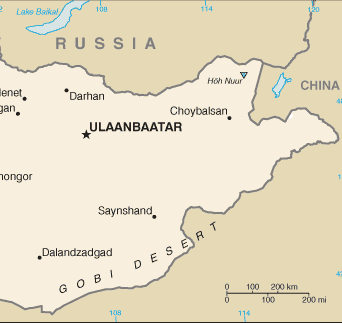
Mongolia: Map
Sponsored links
What to do in Mongolia
For a lot of people, Mongolia is a synonym for the end of the world, infinite distances and the untamed nature of the steppes. This mainly rural country is rich in protected nature and also the generosity of the inhabitants.
One of the rare destinations throughout the world where adventurers are still able to live their dreams, the sheer immensity of the country will strike you as soon as you leave Oulan-Bator, the capital city. The latter is situated on the banks of The Tula and offers surprising contrasts with its Stalinian buildings and the Yurts areas surrounded by wood barriers where the local inhabitants in traditional costumes rub shoulders with others dressed European style, the cars mingling with wandering goats.
Not to be missed is the Tibetan Buddhist monastery, ‘Gandantegchinlen Khiid’, and its temples decorated with precious stones and gold. Around the city, the four holy summits, situated at the cardinal points are excellent for wonderful hikes among forests of larches populated with a variety of wildlife.
You can equally visit the Khustain Nuruu nature reserve, which was created to protect the famous Takki, or Prjevalski, wild horses that used to live in large herds in the Mongolian Steppes. Other place to see is the Khövsgöl Nuur Lake, surrounded by hills, a splendid holy site that should be avoided in the middle of summer due to crowds.
One of the rare destinations throughout the world where adventurers are still able to live their dreams, the sheer immensity of the country will strike you as soon as you leave Oulan-Bator, the capital city. The latter is situated on the banks of The Tula and offers surprising contrasts with its Stalinian buildings and the Yurts areas surrounded by wood barriers where the local inhabitants in traditional costumes rub shoulders with others dressed European style, the cars mingling with wandering goats.
Not to be missed is the Tibetan Buddhist monastery, ‘Gandantegchinlen Khiid’, and its temples decorated with precious stones and gold. Around the city, the four holy summits, situated at the cardinal points are excellent for wonderful hikes among forests of larches populated with a variety of wildlife.
You can equally visit the Khustain Nuruu nature reserve, which was created to protect the famous Takki, or Prjevalski, wild horses that used to live in large herds in the Mongolian Steppes. Other place to see is the Khövsgöl Nuur Lake, surrounded by hills, a splendid holy site that should be avoided in the middle of summer due to crowds.
Mongolia: The basics
You can go to Oulan-Bator in Mongolia by plane via Peking, Moscow or Berlin. A visa is obligatory and you have to provide an invitation or a deposit if you plan to stay longer than 30 days.
The local currency is the tögrög. The budget to plan for is relatively modest, but comfortable conditions are not of the highest level. You can eat for less than €3 and obtain accommodation for between €10 and €30, depending on the services you require: Open plan hotels in Yurts are especially interesting and pleasant.
No vaccinations are obligatory, but as usual, it is recommended to have your normal vaccinations up to date and to be vigilant concerning risks such as rabies in rural areas, AIDS, and drinking water that should be boiled or used from sealed bottles.
Internal travel will often be by plane (there are 80 airports throughout the territory), or by jeep with a driver or guide: Travelling in your own vehicle is not recommended as petrol is not easy to find.
The local currency is the tögrög. The budget to plan for is relatively modest, but comfortable conditions are not of the highest level. You can eat for less than €3 and obtain accommodation for between €10 and €30, depending on the services you require: Open plan hotels in Yurts are especially interesting and pleasant.
No vaccinations are obligatory, but as usual, it is recommended to have your normal vaccinations up to date and to be vigilant concerning risks such as rabies in rural areas, AIDS, and drinking water that should be boiled or used from sealed bottles.
Internal travel will often be by plane (there are 80 airports throughout the territory), or by jeep with a driver or guide: Travelling in your own vehicle is not recommended as petrol is not easy to find.


