Travel quotes
Like all great travellers, I have seen more than I remember, and remember more than I have seen. Benjamin Disraeli
In America there are two classes of travel - first class, and with children. Robert Benchley
Travelers never think that they are the foreigners. Mason Cooley
The traveler was active; he went strenuously in search of people, of adventure, of experience. The tourist is passive; he expects interesting things to happen to him. He goes "sight-seeing." Daniel J. Boorstin
There are only two emotions in a plane: boredom and terror. Orson Welles

Tweet
India : When and where to go ?
Click on a city for complete climate and weather tables
| Town | Jan | Feb | Mar | Apr | May | June | July | Aug | Sept | Oct | Nov | Dec |
| New Delhi | ![]() | ![]() | ![]() | ![]() | ![]() | ![]() | ![]() | ![]() | ![]() | ![]() | ![]() | ![]() |
| Srinagar | ![]() | ![]() | ![]() | ![]() | ![]() | ![]() | ![]() | ![]() | ![]() | ![]() | ![]() | ![]() |
| Darjeeling | ![]() | ![]() | ![]() | ![]() | ![]() | ![]() | ![]() | ![]() | ![]() | ![]() | ![]() | ![]() |
| Calcutta | ![]() | ![]() | ![]() | ![]() | ![]() | ![]() | ![]() | ![]() | ![]() | ![]() | ![]() | ![]() |
| Jaisalmer | ![]() | ![]() | ![]() | ![]() | ![]() | ![]() | ![]() | ![]() | ![]() | ![]() | ![]() | ![]() |
| Hyderabad | ![]() | ![]() | ![]() | ![]() | ![]() | ![]() | ![]() | ![]() | ![]() | ![]() | ![]() | ![]() |
| Bombay | ![]() | ![]() | ![]() | ![]() | ![]() | ![]() | ![]() | ![]() | ![]() | ![]() | ![]() | ![]() |
| Madras | ![]() | ![]() | ![]() | ![]() | ![]() | ![]() | ![]() | ![]() | ![]() | ![]() | ![]() | ![]() |
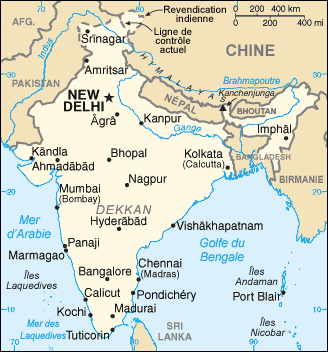
India : Maps and Facts
|
It is not easy to describe the climate of such a vast country: However, it can be mainly divided into three different seasons, a hot season, a wet season and a cold season. |
![]() |
Sponsored links
What to do in India
Country of excess, India provokes very intense feelings in those who venture there.
Delhi, the capital, offers many treasures that the country has as a whole: Countless museums, all categories of restaurants with delicious food, magnificent monuments, various cultural events, all of which can be discovered within the two different worlds of Old Delhi and New Delhi. Agra, 2 hours by train from Delhi, is well known as the home of the Taj Mahal, a beautiful white marble palace built at the request of Emperor Shah Jahan in honor of his love for his deceased wife, this building is justly famous and considered unequaled in its serene beauty by many throughout the world. You should not miss Benares (now called Varanasi), the holy city on the west bank of the Ganges, where you will see various funeral processions on their way to cremations, as well as the pilgrims that come to wash away their sins, also you can discover the Vishwanath Temple, also known as the Golden Temple. Goa, the smallest state, made famous by the hippies during the sixties; has great beaches and coconut palms, a relaxing tropical atmosphere and the people seem to be friendly and happy. In southern India, you will be astonished at the beautiful landscapes of Kerala; the rice fields and tropical plants, the endless beaches and the Thousand and One Nights Palace, the wildlife, rich spices and iridescent colors. Mumbai will turn your head with its excessive and heterogeneous world: Traffic congestion, continuous deafening noise, pollution - everything takes place against a backdrop of impressive sights with a multitude of bazaars, very fashionable boutiques and establishments at the forefront of the twenty-first century. Here, the abject poverty rubs elbows with the air-conditioned shops. However, this city has a special charm you cannot ignore. Madurai with its temple, Udaipur with its palace on Pichola Lake, Jodhpur with its Fort close to the desert, or the various national parks and safaris, where you can see the splendid tigers, all of these will offer wonderful visits during your trip to India. Many travelers are touched by this country: Some of them come back with a tenacious nostalgia close to that of addiction. Your challenge will be to define what makes it so charming and deeply moving that you will probably want to come back: In any case, you will almost certainly find that one visit is not enough! |
India : The basics
Travelling to India by air is the easiest way: You land in Mumbai, Delhi or Madras.
You must have a visa before your journey because you will not be able to get it on arrival. Attention: Make sure you have all the documents required for issuing the visa. The currency in circulation is the Indian Rupee. You can easily change your Euros or Dollars. It is said of India that the cost of living is next to nothing, it's true, except at some places in Mumbai or Delhi. A decent meal can cost less than €5 and a comfortable and reasonable double room less than €15. The food is varied and often delicious and you will discover many specialties depending on different areas and restaurants. The types of accommodation are numerous, mostly hotels from all categories: Choose the one best suited to your budget and taste! Regarding health, take precautions with food: Only drink water from sealed bottles or purified or boiled water, avoid ice cubes and frozen products. Take precautions against diarrhea and follow instructions to protect yourself from malaria if you are believed to be at risk. To travel within the country, domestic flights have recently increased. The train is a possible option, despite its slowness it is cheap and goes everywhere. The buses are less crowded than trains at almost the same price but they are not very comfortable. In large cities, there are a lot of taxis, rickshaws and tongas. You can also rent a bike for less than €1 per day. For souvenirs, you will have a lot of choice, Indian handicrafts are extremely varied: silks in Benares, antiques in Mumbai, rugs and sculptures in Kashmir, embroidered shirts in Delhi, silver jewelry and perfumes in Hyderabad, bronze statuettes in Madras, jewelry and cotton in Rajasthan, pashmina everywhere... |
Towns in India
Capital of India, New Delhi's 13 million inhabitants. Very cosmopolitan city, it makes them mix with residential areas and crowded streets, Hindu temples and mosques.
It is bisected by the River Yamuna, and an international airport connects to various capitals around the world. To move to town, the traditional rickshaw, motorized or not, is the principal means of transport, bus and metro.
It is better to visit the city during the dry season is from September to March. You will receive a warm welcome often and easily find hotels and restaurants are very accessible, where you can sample local specialties often very spicy but delicious, like the biryani or tandoori, accompanied by the famous and quite simple chapati. Many sites are not to be missed in New Delhi with narrow streets and the mosque of Old Delhi Bazaar Chandhi Chowk, Red Fort, the Muslim area of Nizamuddin, the Dilli Haat market where you find all the artisans in the country, and Park Lodhi Garden.
You can also attend some festivities according to the time of the year: the festival of lights in October, or the Holi festival in March. Nevertheless, and despite its intense pollution and traffic crawling, you will not remain insensitive to the charm of this megalopolis very mixed.
Indian Kashmir is now known as Jammu and Kashmir. Located in northern India, it borders with Pakistan, its legitimacy in dispute. China also plays a part, that corresponding to the territories of the Himalayas.
Given this highly charged environment, Kashmir is a recommended destination for tourists for over twenty years. However, this mountainous region offers beautiful scenery, and its capital, Srinagar, will live long in the memory of the visitors taking the risk: built at 1700 meters altitude, is surrounded by mountains, and lakes reflecting the azure the sky.
They also welcome the hundreds of houseboats. You can browse the Old City and its maze of narrow streets, discovering its mosques and in particular the Great Mosque dating from the 17th century, stroll in the famous Mughal gardens towards the end of the Dal Lake, climb the hill to reach the temple dedicated to Shiva , admiring the old fort that surrounds the temple of Sharika Devi, visit the museum, take a boat trip on the lakes, and just drink tea with cardamom in street stalls.
For nature lovers, Dachigam National Park, a former hunting ground of Maharajas, today threatened by the conflict between Pakistan and India, home to the last deer of Kashmir, as well as snow leopards, the Bear and several other species, in sumptuous surroundings. It is located 22 km east of Srinagar.
no description yet
• Calcutta
Capital of the state of West Bengal in India, Calcutta has just over four million inhabitants and more than 15 if one considers the entire city.
Located in the delta of the Ganges, it is built on a swampy, and enjoys a tropical monsoon climate, adding to its moisture painful severe pollution of the city. Important cultural center, the city is the birthplace of many famous novelists, including Rabindra Sangeet.
It also has an interesting historical heritage, as Dakshineshvar Temple, Kali Temple, Victoria Memorial in white marble, the Birla temple, St Paul, Church of St. John is surrounded by a park, botanic garden where you can admire a giant banyan tree (one of the highest in the world), and the area surrounding the College Street Coffee House with its countless shops, book landmark Bengali intellectuals of all stripes. Other sights not to miss the deck Vidyasagar, Indian and the Museum deck Howrah.
But despite his title of cultural capital of India, Calcutta probably hit you its overpopulation, poverty permanently bleak contrast with the color toners, despair, and charm are intertwined, as often in India.
no description yet
• Hyderabad
State capital of Andhra Pradesh, Hyderabad has over 6 million inhabitants. Located between South India and North India, it has a culture and history influenced by these two poles, and cohabitation on the territory of Muslims and Hindus. A monument symbolizes the city: it is a triumphal arch containing a mosque with four minarets. But other buildings rising in the city, earning the visit of tourists: the Mecca Masjid mosque huge can hold ten thousand followers, Golconda Fort, with its crenellated castle, its ramparts and double its ingenious acoustic system adequate to hear the sounds outside, the seven Qutb Tombs of the Kings built amidst a beautiful garden, Birla Mandir temple of white marble statue of the Buddha's high of over 17 meters in the middle of Hussain Sagar Lake, are the most remarkable. Do not miss the discovery of Laad Bazaar, with its artisans and merchants mingled with camels roam, and walk through the bustling streets to fully soak up the atmosphere of the city. There are many possibilities for accommodation at various prices, ranging from the youth hostel in the comfortable.
Bombay is the capital of an Indian state called Maharashtra: it has about 13 million inhabitants. It is the commercial capital of India, and a global financial platform. It also includes the film studios and television schools. Its standard of living is higher than in most other regions of India.
Several sites deserve your attention: the terraced gardens of the Hanging Gardens, the magnificent building of the Chhatrapati Shivaji Terminus, the Prince of Wales Museum, Gateway of India and Indo-moorish style so characteristic of the fountain in the center of Flora the city but also close to the city on Sanjay Gandhi National Park with panthers and hundreds of species of birds, and the Cave of Elephanta, with its sculptures of the 6th century. You can also get lost in the markets and to enjoy the festival of smells and colors, animation and exciting sound of dozens of languages spoken all around you, and you linger a few temples to observe the rituals practiced. Push down to Chowpatty and Juhu beaches, huge and very popular.
Avoid at all events to visit Mumbai between June and September, during hot and humid, where the monsoon may sometimes catastrophic consequences.
For your travel, pending the completion of the Mumbai Metro, taxis and rickshaws are very present and effective.
Now called Chennai, Madras is the capital of the state of Tamil Nadu in South India and has 4.5 people.
Well connected to other major Indian cities by road and air routes or railways, it also has an important port. Its beach, Marina Beach, is the second longest beach in the world, and one of its strengths. The city is also famous for its traditional cuisine, and for being a cultural center are taught music and Carnatic classical dance called Bharatanatyam.
You can visit the zoo and a national park, enjoy the many parks and admire the Fort St. George, the beautiful collection of bronze Government Museum, Temple Kapalishwara, the magnificent Basilica of St. Thomas all white .
You will have no problem finding accommodation in the city, which offers an extensive range of comfort and range of prices, or to eat in the many establishments or street stalls. To move, the traditional rickshaws are perfect.