
America > Paraguay: Weather, Map, Costs and Travel Guide

Paraguay : When and where to go?
Click on a city for complete climate and weather tables
| Town | Jan | Feb | Mar | Apr | May | June | July | Aug | Sept | Oct | Nov | Dec |
| Asuncion |  | |  | | |  | | | | | | |
Paraguay: Climate & Weather
The climate is continental in type with seasons that are inverted compared to those of the northern hemisphere. Summer lasts from January to March with temperatures rising to, and even going beyond, 40°C.
Winter, between July and September, is relatively mild (temperatures around 20°C) but big temperature differences can occur over short periods of time. It is always quite humid whatever the season and rain can bring floods, sometimes of catastrophic proportions. The best time to visit the country is between May and September after the passing of the heavy rains that occur between October and April.
Weather today

Overcast
max. 22 °C
min. 15 °C
Wind: 3 km/h
Precipitation forecast: 0 mm
> Full report and 7-days forecast
Data updated at 07:38 (local time)
At that time, the weather was:
16 °C / Mostly Cloudy
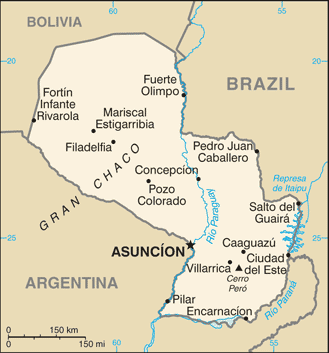
Paraguay: Map
Sponsored links
What to do in Paraguay
A small country with many great qualities, Paraguay suffers from the popularity of its larger neighbours. It has however various attractions; its welcoming population, its history based on an interesting cultural mix and its warm and authentic atmosphere.
The capital, Asuncion has various quarters possessing old colonial architecture. The cathedral too is a building worth seeing as also the Governmental Palace and the Heroes Pantheon at the Eponymous Place. Take a walk around the huge market, visit the Museo del Barro then head for the town outskirts and go to San Bernardino, a lovely spa station, then to Capiata to see its lovely Cathedral with its wooden sculptures and Luques, a town with gold and silversmiths where you can find lovely silver and gold jewellery.
Put aside a little of your time to visit the Jesuit missions; Encarnacion with its markets, Trinidad and Jesus with their ruins classified as a UNESCO Humanitarian World Heritage Site, and the basilisk San Roque Gonzalez de Santa Cruz.
Close to the Ciudad del Este, you can visit the hydraulic complex at Itaipu, the largest in the world, then go to the Iguazu Falls, huge and overpowering.
In the north of the country, at the Cerro Cora National Park, you can discover the local plant and animal life, especially animals including the tapirs, pumas and jaguars.
The capital, Asuncion has various quarters possessing old colonial architecture. The cathedral too is a building worth seeing as also the Governmental Palace and the Heroes Pantheon at the Eponymous Place. Take a walk around the huge market, visit the Museo del Barro then head for the town outskirts and go to San Bernardino, a lovely spa station, then to Capiata to see its lovely Cathedral with its wooden sculptures and Luques, a town with gold and silversmiths where you can find lovely silver and gold jewellery.
Put aside a little of your time to visit the Jesuit missions; Encarnacion with its markets, Trinidad and Jesus with their ruins classified as a UNESCO Humanitarian World Heritage Site, and the basilisk San Roque Gonzalez de Santa Cruz.
Close to the Ciudad del Este, you can visit the hydraulic complex at Itaipu, the largest in the world, then go to the Iguazu Falls, huge and overpowering.
In the north of the country, at the Cerro Cora National Park, you can discover the local plant and animal life, especially animals including the tapirs, pumas and jaguars.
Paraguay: The basics
You can get to Paraguay by plane via Argentina, Bolivia, Brazil or Chile.
No visa is required for a stay of less than 90 days.
The currency in circulation is the Guarani.
The budget required in moderate. A double room will cost less than €20 and you can obtain a decent meal for less than €5. Corn is the staple of the local cuisine but meat has its place too.
Concerning health precautions you should have all your normal vaccinations up to date and add those for hepatitis A and B, typhoid and yellow fever. Avoid drinking tap water and eating raw salads. Consider an anti-malaria treatment.
For inland travel the bus is the most usual form of transport but they are slow and fairly uncomfortable. You can rent a car but beware of the bad state of the roads and the rather fast and erratic driving of the local people.
No visa is required for a stay of less than 90 days.
The currency in circulation is the Guarani.
The budget required in moderate. A double room will cost less than €20 and you can obtain a decent meal for less than €5. Corn is the staple of the local cuisine but meat has its place too.
Concerning health precautions you should have all your normal vaccinations up to date and add those for hepatitis A and B, typhoid and yellow fever. Avoid drinking tap water and eating raw salads. Consider an anti-malaria treatment.
For inland travel the bus is the most usual form of transport but they are slow and fairly uncomfortable. You can rent a car but beware of the bad state of the roads and the rather fast and erratic driving of the local people.


