
America > Argentina: Weather, Map, Costs and Travel Guide

Argentina : When and where to go?
Click on a city for complete climate and weather tables
| Town | Jan | Feb | Mar | Apr | May | June | July | Aug | Sept | Oct | Nov | Dec |
| Buenos Aires |  | | |  | | |  | | | | | |
Argentina: Climate & Weather
The climate varies greatly in accordance with the layout of the country: Sub-tropical in the north-east, it is humid in the centre and cooler towards the south. In the north, heat and heavy rains dominate from December to March.
It snows between July and August in the Andes. A large part of Patagonia experiences fairly warm temperatures all year round, especially in the east where hiking is very pleasant between November and March.
The ideal time to visit the whole of the country is around October/November or March/April, thus avoiding the oppressing heat of the north and the severe cold of the south.
Weather today

Partly Cloudy
max. 13 °C
min. 9 °C
Wind: 3 km/h
Precipitation forecast: 0 mm
> Full report and 7-days forecast
Data updated at 07:43 (local time)
At that time, the weather was:
9 °C / Overcast
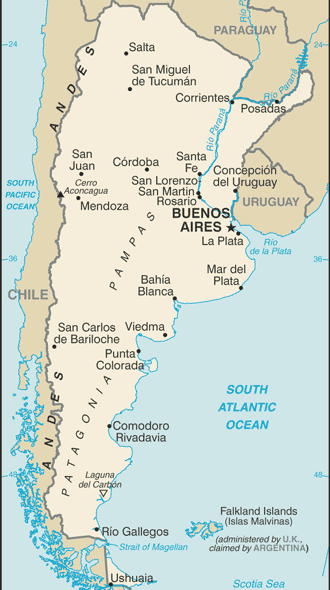
Argentina: Map
Sponsored links
What to do in Argentina
An immense under-populated country, Argentina is a land of adventure and otherworldliness.
The Capital, Buenos Aires, is not shy about showing its cosmopolitan side to the traveller on their arrival: Its long streets bursting with shops, the Metropolitana Cathedral, the Colon Theatre with its world renowned shows, the Museo Ambrosetti with its magnificent Indian objects, the painted wooden houses in La Boca, the Recoleta Cemetery with its superb mausoleums, the parish of San Telmo with its antiquarian shops, the gigantic ‘avenida 9 de Julio’, all give you a glimpse of the numerous attractions of this town.
Cordoba, the second largest city in the country, has a very interesting historical
centre, in particular the old market and the churches dating from the 16th Century with their heteroclite architecture.
Definitely not to be missed are the Iguazu waterfalls: A stupefying vision of thousands of cubic metres of water flowing from a height of 70 metres which are in themselves worthy of a visit but they are also surrounded by virgin forest which is excellent for hiking trips to discover the rich and varied local fauna and flora.
Patagonia will certainly satisfy any desire you have to visit the ends of the earth: The National Glacier Park, a boat trip on the Lago Argentino to visit the icebergs, a trek into the Andes, the Tierra del Fuego National Park, a visit to an ‘estancia’ or to the penal colony of Ushuaïa will leave you with unforgettable memories.
The Capital, Buenos Aires, is not shy about showing its cosmopolitan side to the traveller on their arrival: Its long streets bursting with shops, the Metropolitana Cathedral, the Colon Theatre with its world renowned shows, the Museo Ambrosetti with its magnificent Indian objects, the painted wooden houses in La Boca, the Recoleta Cemetery with its superb mausoleums, the parish of San Telmo with its antiquarian shops, the gigantic ‘avenida 9 de Julio’, all give you a glimpse of the numerous attractions of this town.
Cordoba, the second largest city in the country, has a very interesting historical
centre, in particular the old market and the churches dating from the 16th Century with their heteroclite architecture.
Definitely not to be missed are the Iguazu waterfalls: A stupefying vision of thousands of cubic metres of water flowing from a height of 70 metres which are in themselves worthy of a visit but they are also surrounded by virgin forest which is excellent for hiking trips to discover the rich and varied local fauna and flora.
Patagonia will certainly satisfy any desire you have to visit the ends of the earth: The National Glacier Park, a boat trip on the Lago Argentino to visit the icebergs, a trek into the Andes, the Tierra del Fuego National Park, a visit to an ‘estancia’ or to the penal colony of Ushuaïa will leave you with unforgettable memories.
Argentina: The basics
Various airlines serve the Buenos Aires airport.
No visa is required.
The currency used is the Argentinean Peso.
Your required budget will be fairly modest: A double room will cost you around €25 except in Patagonia where the prices are somewhat higher. A good and filling meal, generally meat based, comes to less than €7.
Health precautions generally concern the classic vaccinations to which should be added yellow fever (recently added, again, in 2008), hepatitis A, typhoid and rabies. One particular local problem can be altitude sickness, or ‘sorroche’, which can affect climbers above an altitude of 3,000 metres. On experiencing the slightest symptom the only solution is to descend as fast as possible.
To move around within the country, interior airlines exist, especially destined for Patagonia, but there are also fast, comfortable buses. Travelling by train is another solution, some of them take spectacular routes cross country.
No visa is required.
The currency used is the Argentinean Peso.
Your required budget will be fairly modest: A double room will cost you around €25 except in Patagonia where the prices are somewhat higher. A good and filling meal, generally meat based, comes to less than €7.
Health precautions generally concern the classic vaccinations to which should be added yellow fever (recently added, again, in 2008), hepatitis A, typhoid and rabies. One particular local problem can be altitude sickness, or ‘sorroche’, which can affect climbers above an altitude of 3,000 metres. On experiencing the slightest symptom the only solution is to descend as fast as possible.
To move around within the country, interior airlines exist, especially destined for Patagonia, but there are also fast, comfortable buses. Travelling by train is another solution, some of them take spectacular routes cross country.


