
Africa > Tunisia: Weather, Map, Costs and Travel Guide

Tunisia : When and where to go?
Click on a city for complete climate and weather tables


Tunisia: Climate & Weather
The Mediterranean climate is predominant on the Tunisian territory: Temperatures are higher in the south, but the summer is hot and dry throughout the country, spring and autumn are mild and winters are cold and very damp. It can snow on the mountains whereas some desert areas do not experience rainfall from one year to another.
Spring is a particularly a mild season, but October and November are very conducive to discovering the oases in the south. The months to avoid are January and February; they are the coldest with the most rainfall. The summer season too should be avoided when heat waves and crowds make a holiday less enjoyable.
Weather today

Clear
max. 33 °C
min. 22 °C
Wind: 7 km/h
Precipitation forecast: 0 mm
> Full report and 7-days forecast
Data updated at 11:19 (local time)
At that time, the weather was:
33 °C / Clear
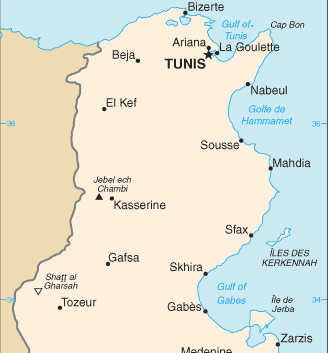
Tunisia: Map
Sponsored links
What to do in Tunisia
Rich in its history influenced by various civilizations, Tunisia also has many diverse and beautiful landscapes.
Tunis, the capital, has many attractions: The Medina built in the7th century, the Zaytuna Mosque, the perfume-makers’ market at Souk el-Attarine, the Tourbet el-Bey mausoleum, the centre of Popular Arts and Traditions, the Cathedral of St. Vincent and the Bardo Museum are just some examples.
Carthage is a must-see place, even if it may prove slightly disappointing due to the lack of remaining remains on the site: The Punic area of Byrsa, the ruins of the Antoninus Baths, the St. Louis Cathedral, the amphitheater where only the arena only remains, the tophet where children were sacrificed to the gods and the El Abidine mosque, are the main discovery stopovers of this town.
Sidi Bou Saïd is a charming town overlooking the sea where you will enjoy strolling between the white walled houses decorated with bright blue railings and flowered patios, on the central square are various stores.
Discover the south of Tunisia by going down to the Tozeur and Nafta oases, with their palms rising up from the middle of the desert, and their vivacious old town areas.
The island of Djerba will give you the opportunity to enjoy some relaxation on its beautiful beaches and also pleasant walks through the souks of Houmt-Souk to contemplate its beautiful mosques.
Tunis, the capital, has many attractions: The Medina built in the7th century, the Zaytuna Mosque, the perfume-makers’ market at Souk el-Attarine, the Tourbet el-Bey mausoleum, the centre of Popular Arts and Traditions, the Cathedral of St. Vincent and the Bardo Museum are just some examples.
Carthage is a must-see place, even if it may prove slightly disappointing due to the lack of remaining remains on the site: The Punic area of Byrsa, the ruins of the Antoninus Baths, the St. Louis Cathedral, the amphitheater where only the arena only remains, the tophet where children were sacrificed to the gods and the El Abidine mosque, are the main discovery stopovers of this town.
Sidi Bou Saïd is a charming town overlooking the sea where you will enjoy strolling between the white walled houses decorated with bright blue railings and flowered patios, on the central square are various stores.
Discover the south of Tunisia by going down to the Tozeur and Nafta oases, with their palms rising up from the middle of the desert, and their vivacious old town areas.
The island of Djerba will give you the opportunity to enjoy some relaxation on its beautiful beaches and also pleasant walks through the souks of Houmt-Souk to contemplate its beautiful mosques.
Tunisia: The basics
The plane is the fastest means of transportation from Europe, arriving in Tunis, Djerba or Monastir.
A visa is not required if you are European and your stay does not exceed three months.
The currency in circulation is the Tunisian dinar.
For your budget, anticipate €12 for an average meal in a small local restaurant, and less than €30 for a double room with breakfast.
There are no special health precautions to take; only protect yourself against the sun and the usual recommendations apply about not drinking tap water, don’t forget to peel fruit and vegetables.
For transportation within the country, the SNTRI buses are quick and inexpensive. Another good solution is the shared taxis.
For those who wish to take souvenirs home to their friends and family, the souks and craftwork markets will give you plenty to choose from: Silver jewellery, carpets, Nabeul pottery, leather slippers, copper plates, blankets, basketwork, spices....
A visa is not required if you are European and your stay does not exceed three months.
The currency in circulation is the Tunisian dinar.
For your budget, anticipate €12 for an average meal in a small local restaurant, and less than €30 for a double room with breakfast.
There are no special health precautions to take; only protect yourself against the sun and the usual recommendations apply about not drinking tap water, don’t forget to peel fruit and vegetables.
For transportation within the country, the SNTRI buses are quick and inexpensive. Another good solution is the shared taxis.
For those who wish to take souvenirs home to their friends and family, the souks and craftwork markets will give you plenty to choose from: Silver jewellery, carpets, Nabeul pottery, leather slippers, copper plates, blankets, basketwork, spices....


