
Africa > Libya: Weather, Map, Costs and Travel Guide

Warning: high risk destination.
Libya : When and where to go?
Click on a city for complete climate and weather tables
| Town | Jan | Feb | Mar | Apr | May | June | July | Aug | Sept | Oct | Nov | Dec |
| Tripoli |  | |  | | |  | | | | | | |
Libya: Climate & Weather
Libya’s climate has two very distinctive influences; that of the Mediterranean in the northern part which gives moderate temperatures and that of the deserts in the centre which experiences dryness most of the year.
Along the coastline, winter is the rainy season, even if it isn’t often heavy.
Spring and autumn bring dry hot winds from the south.
The wintertime is the best season for visiting Libya, offering warm temperatures and so avoiding unpleasant sand storms.
Weather today

Partly Cloudy
max. 30 °C
min. 24 °C
Wind: 10 km/h
Precipitation forecast: 0 mm
> Full report and 7-days forecast
Data updated at 04:11 (local time)
At that time, the weather was:
 25 °C / Overcast
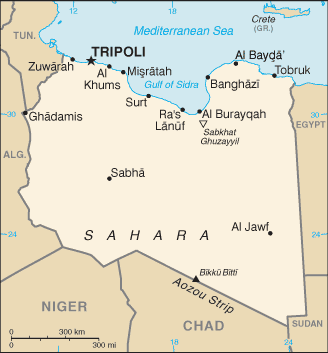
Libya: Map
Sponsored links
What to do in Libya
Still off the beaten track for tourists, Libya has many beautiful places to offer.
The capital, Tripoli, is distinguished by its architecture, heavily influenced by the Ottomans and Italians. You can visit the fortress at Assai al-Hamra, the Jamahiriyya Museum with its many magnificent objects dating back into antiquity. The medina and souks here are also worth a visit, generally calmer than in other places. Close by there are some beautiful beaches too.
Ghadamès Oasis makes an interesting stopover with its shady old town and the D’jmaa al-Kabir Mosque. A few miles away a lovely lake can be found in the middle of the desert.
The archaeological site of Leptis Magna is a place not to be missed. Dating back to a few centuries BC, the town’s old ruins were rediscovered during the last century and are in a fairly good state of preservation. Its triumphal Arch, the marble Hadrian baths, the nymphaem, basilica and the amphitheatre are just a few examples of the marvels waiting to be discovered amongst the Roman ruins here.
The Jebel Akhdar mountain chain makes an unusual lush green paradise amongst the hot desert sands here. Agriculturally rich with cereal fields and orchards, this area has various old towns that are definitely worth visiting such as Tocra and Tolmeitawhich are both close to the coast and El-Beida and Suluntah which are slightly inland as well as Derna with its covered souk.
The ancient Greek city of Cyrene is another archaeological site worth visiting. Situated in the Jebel Akhdar mountains and very well preserved, it benefits from a dominant position offering magnificent views and a large part is yet to see the light of day.
The capital, Tripoli, is distinguished by its architecture, heavily influenced by the Ottomans and Italians. You can visit the fortress at Assai al-Hamra, the Jamahiriyya Museum with its many magnificent objects dating back into antiquity. The medina and souks here are also worth a visit, generally calmer than in other places. Close by there are some beautiful beaches too.
Ghadamès Oasis makes an interesting stopover with its shady old town and the D’jmaa al-Kabir Mosque. A few miles away a lovely lake can be found in the middle of the desert.
The archaeological site of Leptis Magna is a place not to be missed. Dating back to a few centuries BC, the town’s old ruins were rediscovered during the last century and are in a fairly good state of preservation. Its triumphal Arch, the marble Hadrian baths, the nymphaem, basilica and the amphitheatre are just a few examples of the marvels waiting to be discovered amongst the Roman ruins here.
The Jebel Akhdar mountain chain makes an unusual lush green paradise amongst the hot desert sands here. Agriculturally rich with cereal fields and orchards, this area has various old towns that are definitely worth visiting such as Tocra and Tolmeitawhich are both close to the coast and El-Beida and Suluntah which are slightly inland as well as Derna with its covered souk.
The ancient Greek city of Cyrene is another archaeological site worth visiting. Situated in the Jebel Akhdar mountains and very well preserved, it benefits from a dominant position offering magnificent views and a large part is yet to see the light of day.
Libya: The basics
The airlines are starting to visit Libya again with flights departing from various major European airports.
A visa is required for the majority of foreigners.
The currency in circulation is the Libyan Dinar. You can only exchange your currency when you are actually there so make sure you take a sufficient amount of cash.
An average meal will cost you around €10 and a reasonable hotel room around €60.
No particular vaccinations are required to visit Libya but you are advised to ensure all normal vaccinations are up to date plus those for typhoid and hepatitis A and B. Do not drink tap water. It is recommended that you take a basic first aid kit with you.
To travel inland, buses and minibuses are both efficient and reasonably priced. Renting a car is fairly expensive but petrol isn’t and the road system seems in excellent condition.
Advice: Alcohol is strictly forbidden and bartering isn’t traditional in Libyan souks.
A visa is required for the majority of foreigners.
The currency in circulation is the Libyan Dinar. You can only exchange your currency when you are actually there so make sure you take a sufficient amount of cash.
An average meal will cost you around €10 and a reasonable hotel room around €60.
No particular vaccinations are required to visit Libya but you are advised to ensure all normal vaccinations are up to date plus those for typhoid and hepatitis A and B. Do not drink tap water. It is recommended that you take a basic first aid kit with you.
To travel inland, buses and minibuses are both efficient and reasonably priced. Renting a car is fairly expensive but petrol isn’t and the road system seems in excellent condition.
Advice: Alcohol is strictly forbidden and bartering isn’t traditional in Libyan souks.


