
Africa > Burkina Faso > Ouagadougou: Weather, Climate and Travel Guide

Weather today Rain max. 38 °C
min. 29 °C Wind: 10 km/h Precipitation forecast: 3 mm > Full report and 7-days forecast Data updated at 14:30 (local time) At that time, the weather was:  38 °C / Overcast
|
Sponsored links |
When to go to Ouagadougou? (Burkina Faso)
| Month | Sunlight (h/d) | Average T min (°C) | Average T max (°C) | Record T min (°C) | Record T max (°C) | Precipitations (mm) | Wet days | Rating |
| January | 9 | 17 | 34 | 9 | 44 | 0 | 0 |  |
| February | 9 | 21 | 38 | 12 | 46 | 3 | 0 |  |
| March | 9 | 24 | 41 | 15 | 44 | 12 | 0 |  |
| April | 8 | 27 | 40 | 15 | 48 | 14 | 2 |  |
| May | 9 | 27 | 39 | 19 | 47 | 83 | 6 | |
| June | 8 | 25 | 37 | 17 | 45 | 121 | 9 | |
| July | 7 | 24 | 34 | 18 | 40 | 202 | 12 | |
| August | 6 | 23 | 32 | 14 | 39 | 276 | 14 | |
| September | 7 | 24 | 33 | 19 | 38 | 144 | 11 | |
| October | 9 | 24 | 36 | 18 | 42 | 32 | 3 | |
| November | 9 | 23 | 37 | 16 | 41 | 0 | 0 | |
| December | 8 | 18 | 36 | 11 | 46 | 0 | 0 | |
What to do in Ouagadougou : Tips, places, hotels and restaurants
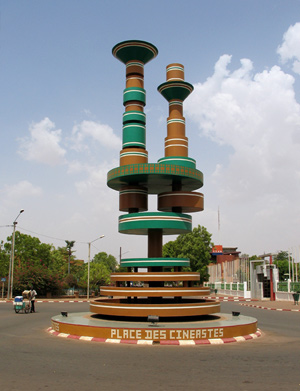 Burkina Faso's capital, Ouagadougou, has almost one million five hundred thousand inhabitants. The economic and cultural centre of the country, the city was founded in the 11th Century, and its population hasn’t stopping increasing since the arrival of the railway in the city in the 50s. Located in the centre of the country, it enjoys a tropical climate with a rainy season which starts in April, and a dry season starting from October and accompanied by a very dry wind, the harmattan. It is warmest in February and March with temperatures reaching 40°C. The city is served by an international airport and a train from Abidjan. A bus service enables travel around the city, but two-wheelers are the means of transport most used by residents. Tourism is relatively undeveloped, but in the city you will find one of the largest markets in West Africa, and you may participate in the Pan African Film and Television Festival or the International Exhibition of Handicrafts. Tourist accommodation has seen a marked growth recently with nearly 200 hotel establishments, offering a total of nearly 4,000 rooms.


